


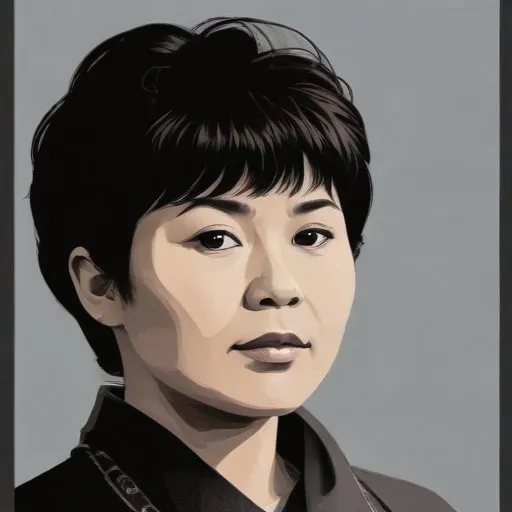
A pioneering artist who explored the intersection of sculpture and wire, creating intricate, biomorphic forms that blur the lines between art and mathematics.
Ruth Asawa is a renowned American modernist artist known for her innovative and intricate looped-wire sculptures inspired by natural and organic forms. Her unique style, characterized by biomorphic and lyrical shapes, has made her a pioneer in the world of modern art.
Ruth Asawa was born on January 24, 1926, in Norwalk, California, to Japanese immigrant parents. Growing up on a truck farm, she was the fourth of seven children. Despite facing the challenges of Japanese-American isolation policies during World War II, Asawa's passion for art persisted.
Asawa's artistic journey began in 1942, while interned at the Rohwer Relocation Center in Arkansas, where she learned drawing from illustrators interned at the camp. This experience laid the foundation for her future success.
In 1943, Asawa attended Milwaukee State Teachers College, where she hoped to become a teacher. However, her Japanese ancestry prevented her from obtaining a teaching position in Wisconsin. This setback led her to join the avant-garde artistic community at Black Mountain College in North Carolina in 1946.
Under the guidance of influential artists such as Josef Albers and Buckminster Fuller, Asawa honed her skills and developed her unique style. Her travels to Mexico in 1947 introduced her to basket crocheting techniques, which she later adapted to create her iconic looped-wire sculptures.
Asawa's breakthrough came in 1955 with her first exhibition in New York. By the early 1960s, she had achieved commercial and critical success, becoming an advocate for public art. Her belief in "art for everyone" drove her to champion public art initiatives, making her a driving force behind the creation of the San Francisco School of the Arts.
Today, Asawa's work is featured in esteemed collections, including the Solomon R. Guggenheim Museum and the Whitney Museum. Her influence on modern art is undeniable, inspiring generations of artists to experiment with new techniques and materials.
In 2010, the San Francisco School of the Arts was renamed the Ruth Asawa San Francisco School of the Arts in her honor, cementing her legacy as a pioneering artist and educator.
Ruth Asawa's remarkable life and artistic contributions serve as a testament to the power of creativity, perseverance, and dedication. Her legacy continues to inspire artists, educators, and enthusiasts alike, ensuring that her art will remain a vital part of our cultural heritage for generations to come.
Born in 1883
Pioneering photographer capturing intimate botanicals, industrial landscapes, and portraits, pushing boundaries of modernist photography.
Born in 1895
Documented the lives of those affected by the Great Depression and the Dust Bowl through powerful, poignant photographs that humanized the struggles of the era. Captured iconic images that shaped the national conversation around poverty and social justice.
Born in 1902
Pioneering landscape photographer and conservationist capturing iconic black-and-white images of the American West, advocating for environmental protection through art.
Born in 1886
A prominent figure in Mexican muralism, creating large-scale public artworks that often depicted the country's history and social issues, blending realism with symbolism.
Born in 1907
A Mexican artist who created vibrant, emotional, and often unsettling paintings that explored her own experiences with physical and emotional pain, as well as her cultural heritage.
Born in 1888
A pioneering artist and educator who explored the properties of color and its effects on human perception through his work, creating a new language of art.
Born in 1903
A pioneer of abstract expressionism, creating bold, rectangular color fields that evoke emotions and spark introspection. His works are a testament to the power of art to transcend language and culture.
Born in 1904
A pioneering abstract expressionist, creating large-scale, gestural paintings that explored the human experience and the American West. Known for his bold, expressive brushstrokes and vibrant color palette.
