


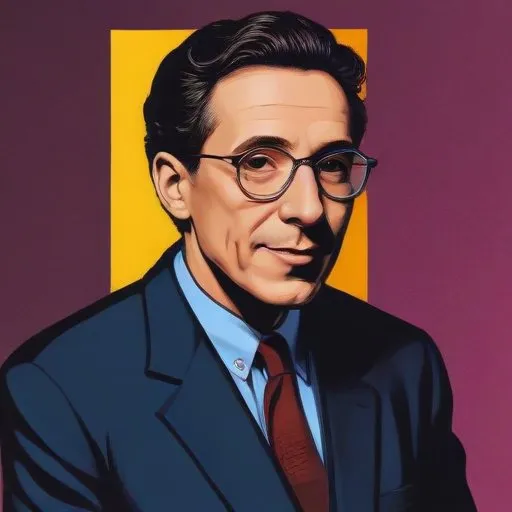
Developed the neutron bomb, a tactical nuclear weapon designed to kill people while minimizing damage to buildings and infrastructure. This invention sparked controversy and debate about the ethics of nuclear warfare.
Samuel T. Cohen, an American physicist, is credited with developing the neutron bomb, a weapon designed to maximize damage to living organisms while minimizing damage to buildings and infrastructure. This creation has been attributed to his work on the Manhattan Project, where he calculated the behavior of neutrons in atomic bombs.
Cohen was born on January 25, 1921, in Brooklyn, New York, to Austrian Jewish parents who emigrated from London, England. He grew up in New York City, developing a passion for mathematics and physics, which led him to study at the University of California, Los Angeles (UCLA).
After the Japanese attack on Pearl Harbor, Cohen joined the United States Army and worked on the Manhattan Project in the efficiency group at Los Alamos. His calculations on neutron behavior in Fat Man, the atomic bomb detonated over Nagasaki, Japan, played a crucial role in the project's success.
Following the war, Cohen pursued his Ph.D. at the University of California, Berkeley, but eventually dropped out to join the RAND Corporation in 1950. Here, his work on the intensity of fallout radiation became public, featured as a special appendix in Samuel Glasstone's book, "The Effects of Atomic Weapons."
Cohen's most notable contribution, the neutron bomb, was designed to reduce collateral damage while increasing the devastating effects on human life. During the Vietnam War, he advocated for its use, arguing it would quickly end the conflict and save American lives. However, politicians and scientists were skeptical, and the weapon's development was delayed.
Cohen's work had a significant impact on modern warfare and national defense strategies. He recruited renowned strategist Herman Kahn into the RAND Corporation and was a member of the Los Alamos Tactical Nuclear Weapons Panel in the early 1970s. Cohen claimed to have convinced President Ronald Reagan to develop 700 neutron bombs during his presidency.
Samuel T. Cohen's neutron bomb has had a lasting impact on military strategy and international relations. His work has been the subject of controversy, with some praising its potential to reduce collateral damage and others criticizing its devastating effects on human life. Regardless, Cohen's legacy as the father of the neutron bomb remains an important chapter in the history of modern warfare.
98 Years Old
Visionary filmmaker behind iconic, visually stunning, and thought-provoking movies that often explored the human condition, pushing boundaries of storytelling and cinematography.
Born in 1908
Developed the hydrogen bomb and was a key figure in the development of the US nuclear program, known for his advocacy of nuclear energy and his role in the Cold War.
Born in 1906
A renowned physicist and Nobel laureate who made groundbreaking contributions to our understanding of the universe, particularly in the fields of nuclear physics and astrophysics.
Born in 1918
A brilliant physicist and engineer who pioneered quantum mechanics and famously explained complex concepts in simple terms, making science accessible to all.
Born in 1904
Leading the development of the atomic bomb during World War II, this brilliant mind made groundbreaking contributions to theoretical physics, pushing the boundaries of human understanding.
Born in 1901
A pioneer in nuclear physics, known for leading the team that developed the first nuclear reactor and playing a crucial role in the development of the atomic bomb.
Born in 1898
A pioneer in nuclear physics, known for conceiving the idea of a nuclear chain reaction and patenting the concept of a nuclear reactor. He also played a key role in persuading Einstein to warn Roosevelt about the possibility of Germany developing an atomic bomb.
Born in 1903
Pioneering mathematician and physicist who developed the concept of the modern computer architecture and made significant contributions to quantum mechanics and game theory. His work laid the foundation for modern computing and artificial intelligence.
