


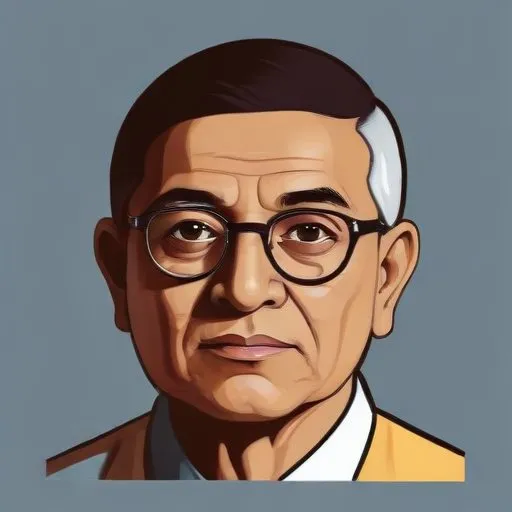
Indian statesman who played a key role in India's struggle for independence and later served as the Chief Minister of Bihar, known for his efforts to promote education and social reform.
Satyendra Narayan Sinha, affectionately known as Chhote Saheb, was a stalwart of Indian politics and a prominent figure in the Indian independence movement. He is revered for his unwavering commitment to the cause, his seven-time tenure as Member of Parliament from the Aurangabad constituency, and his stint as the Chief Minister of Bihar.
Born on July 12, 1917, in Poiwan, Aurangabad district, Bihar, Sinha was part of an aristocratic political family. His father, Dr. Anugrah Narayan Sinha, was a nationalist leader who played a significant role in the Champaran Satyagraha movement alongside Mahatma Gandhi and Dr. Rajendra Prasad. Sinha's upbringing in a political environment and his education under the tutelage of Lal Bahadur Shastri at Allahabad University laid the foundation for his future in politics.
Sinha completed his bachelor's degree from Allahabad University and earned a law degree from Lucknow University. He practiced law at the Patna High Court before leaving his job to join the Indian Independence movement. He actively participated in the Quit India Movement in 1942 and organized Legal Aid Programs for political prisoners during pre-Independence days.
After India gained independence, Sinha was elected to the provisional Parliament from Bihar in 1950. He was part of the young Turk brigade of the Indian National Congress party during the time of Jawaharlal Nehru. Sinha's extensive experience in politics and public service led him to become a prominent educationist, and he served as a three-term Member of the Bihar Legislative Assembly and a Member of the Bihar Legislative Council once.
Sinha was known for his strict discipline and tough taskmaster approach, earning him widespread respect. His reputation as one of India's most influential regional leaders of the time was synonymous with his unwavering commitment to the betterment of Bihar and its people.
Satyendra Narayan Sinha's legacy continues to inspire generations of Indian politicians and citizens alike. His untiring efforts towards the betterment of Bihar and India earned him a permanent place in the annals of Indian history. As a statesman, educationist, and politician, Sinha's contributions will forever be remembered and cherished.
Sinha passed away on September 4, 2006, leaving behind a rich legacy of public service, discipline, and integrity. His life and times serve as a testament to the power of unwavering commitment to the cause of nation-building.
Born in 1889
India's first Prime Minister, a key figure in the country's struggle for independence from British rule, and a champion of democracy and secularism. He played a crucial role in shaping modern India's government and economy.
Born in 1917
The first female Prime Minister of India, serving from 1966 to 1977 and again from 1980 until her assassination in 1984, known for her strong leadership and economic reforms.
Born in 1884
India's first president, a key figure in the country's struggle for independence, who played a crucial role in shaping the nation's early years. He's revered for his leadership and commitment to democracy.
Born in 1896
Fourth Prime Minister of India, known for his efforts to decentralize power and promote economic development, and for being the first Indian Prime Minister to resign from office.
Born in 1924
A renowned Indian poet and politician who served as the country's 10th Prime Minister, known for his efforts to strengthen India's economy and improve relations with neighboring countries.
Born in 1904
The second Prime Minister of India, leading the country through a tumultuous period, including a war with Pakistan, and known for his simplicity, honesty, and dedication to the nation. He is also credited with promoting the Green Revolution, which transformed India's agricultural sector.
Born in 1898
Indian politician who served as the Acting Prime Minister of India twice, known for his leadership during critical periods of Indian history.
Born in 1902
The 5th Prime Minister of India, a champion of rural development and social justice, who implemented land reforms and empowered farmers. He played a crucial role in shaping India's agricultural sector and economy.
