


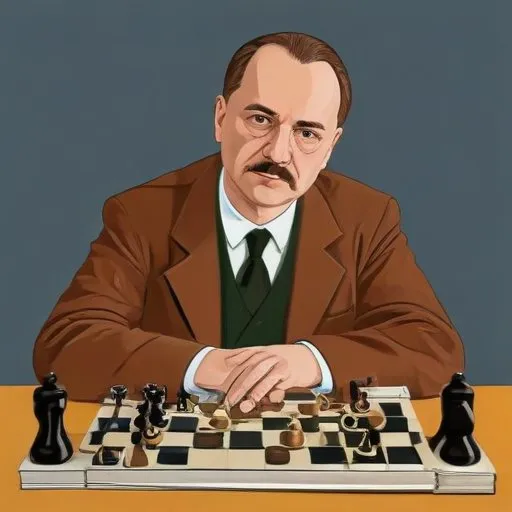
A Polish journalist, author, and chess player who wrote humorous chess books and was a chess grandmaster, known for his witty annotations and contributions to chess literature.
Savielly Tartakower, also known as Xavier or Ksawery Tartakower, is renowned for being one of the most exceptional chess players of the early 20th century, earning the title of International Grandmaster in 1950. As a leading chess journalist and author, Tartakower's witty remarks and insightful writings have left an indelible mark on the world of chess.
Tartakower was born on February 21, 1887, in Rostov-on-Don, Russia, to Austrian citizens of Jewish origin. His early life was marked by tragedy, with his parents falling victim to a pogrom in Rostov-on-Don in 1911. He later moved to Austria, graduating from the law faculties of universities in Geneva and Vienna, and becoming proficient in German and French.
It was during his studies that Tartakower developed a passion for chess, frequenting various chess meetings in Vienna's cafes, where he encountered notable masters of the time, including Carl Schlechter, Géza Maróczy, Milan Vidmar, and Richard Réti.
Tartakower's first notable achievement was winning a tournament in Nuremberg in 1906, followed by a second-place finish in Vienna in 1909. His talent and dedication earned him recognition, and he soon became a prominent figure in the chess world.
Drafted into the Austro-Hungarian army during World War I, Tartakower served as a staff officer, later emigrating to France and settling in Paris. Despite not speaking Polish, he accepted Polish citizenship in 1918 and became one of Poland's most distinguished honorary ambassadors.
Tartakower was a prolific writer, contributing to various chess magazines and authoring several books on the subject. His witty remarks and clever sayings have become an integral part of chess culture, earning him the nickname "the witty Tartakower."
Tartakower's philosophical approach to chess was characterized by his emphasis on the importance of strategic planning and creative thinking. He believed that chess was not solely a game of calculation, but rather an art form that required a deep understanding of human psychology and behavior.
Tartakower's contributions to chess have had a lasting impact on the game, inspiring generations of chess players and writers. His legacy extends beyond the chessboard, serving as a testament to the power of resilience, determination, and creative genius.
Savielly Tartakower's life and achievements serve as a rich tapestry, woven from the threads of passion, talent, and wit. His remarkable journey continues to captivate and inspire, a true testament to the enduring spirit of a chess grandmaster.
Born in 1899
A Russian-born novelist and critic, renowned for crafting intricate, lyrical prose and exploring themes of identity, morality, and the human condition through works like "Lolita" and "Pale Fire".
Born in 1892
A Russian chess grandmaster and writer who dominated the game during the early 20th century, holding the World Chess Championship title from 1927 to 1946 and 1948 to 1946.
Born in 1868
A German polymath who excelled in chess, mathematics, and philosophy, making groundbreaking contributions to these fields, including the development of algebraic geometry and the concept of Hilbert space.
Born in 1889
A Slovak-Czech chess grandmaster and author, known for his contributions to chess theory and his book "Modern Ideas in Chess", which introduced innovative concepts to the game.
Born in 1862
A German chess master and influential strategist, renowned for his contributions to opening theory and advocacy for rational, positional play.
Born in 1886
A renowned chess strategist and author, known for developing the "hypermodern" style of play and writing influential books on chess theory.
Born in 1837
A chess prodigy who dominated the game in the 19th century with his exceptional skill and innovative strategies, leaving a lasting impact on the sport.
