


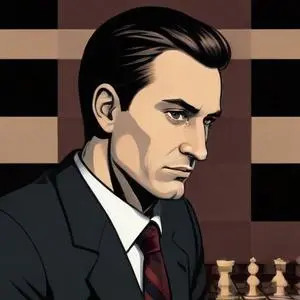
A renowned chess strategist and author, known for developing the "hypermodern" style of play and writing influential books on chess theory.
Renowned for revolutionizing the game of chess with his innovative hypermodern approach, Aron Nimzowitsch was a Latvian-born Danish chess player and writer who left an indelible mark on the world of chess. His influential book, My System, published in 1925-1927, is still studied and revered by chess enthusiasts today.
Born on November 7, 1886, in Riga, Russian Empire, Nimzowitsch came from a wealthy Jewish family. His father, Shaya Abramovich Nimzowitsch, was a timber merchant who taught him chess at a young age. Nimzowitsch's early life was marked by a strong academic inclination, and he moved to Berlin in 1904 to study philosophy. However, his passion for chess soon took over, and he abandoned his studies to pursue a career as a professional chess player.
Nimzowitsch's hypermodern approach to chess, which emphasized controlling the center with pawns and fianchettoing the bishops, revolutionized the game. His ideas, outlined in My System, influenced generations of chess players, including world champions like Tigran Petrosian and Bobby Fischer. Nimzowitsch's legacy extends beyond his own playing career, with his ideas continuing to shape modern chess strategies.
During the 1917 Russian Revolution, Nimzowitsch feigned madness to avoid being drafted into the army, claiming that a fly was on his head. He eventually escaped to Berlin and later moved to Copenhagen, where he lived a simple life in a small rented room.
Aron Nimzowitsch's contributions to chess theory and his innovative playing style have cemented his place as one of the greatest chess players of all time. His influence can be seen in the many chess players who have followed in his footsteps, and his legacy continues to inspire and educate chess enthusiasts around the world.
"The pawn is the soul of chess."
"Prophylactic thinking is a powerful weapon in chess."
These quotes, among many others, showcase Nimzowitsch's profound understanding of the game and his ability to articulate complex ideas in simple, yet powerful, terms.
Aron Nimzowitsch passed away on March 16, 1935, in Copenhagen, Denmark. His final years were marked by declining health, but his legacy continues to thrive, inspiring future generations of chess players and enthusiasts. Today, Nimzowitsch remains an iconic figure in the world of chess, his ideas and contributions still studied and revered by the chess community.
Born in 1868
A German polymath who excelled in chess, mathematics, and philosophy, making groundbreaking contributions to these fields, including the development of algebraic geometry and the concept of Hilbert space.
Born in 1892
A Russian chess grandmaster and writer who dominated the game during the early 20th century, holding the World Chess Championship title from 1927 to 1946 and 1948 to 1946.
Born in 1901
A Dutch chess grandmaster, mathematician, and author who made significant contributions to chess theory and was a world chess champion from 1935 to 1937. He's also known for his books on chess strategy.
Born in 1921
A renowned chess grandmaster and seventh World Chess Champion, known for his strategic and positional playing style, which earned him the title of "Chess Philosopher".
Born in 1911
A Soviet chess grandmaster and engineer who dominated the game from the 1940s to 1960s, winning six World Chess Championships and developing the first chess-playing computer program.
97 Years Old
Armenian chess grandmaster who reigned as World Chess Champion from 1963 to 1969, known for his defensive playing style and ability to draw games from seemingly impossible positions.
89 Years Old
A Soviet chess grandmaster who dominated the game in the 1960s and 1970s, famously competing against Bobby Fischer in the 1972 World Chess Championship. He is known for his strategic and positional playing style.
95 Years Old
A Russian chess grandmaster and author, known for his exceptional endgame skill and candid memoirs about the Soviet chess scene.
