


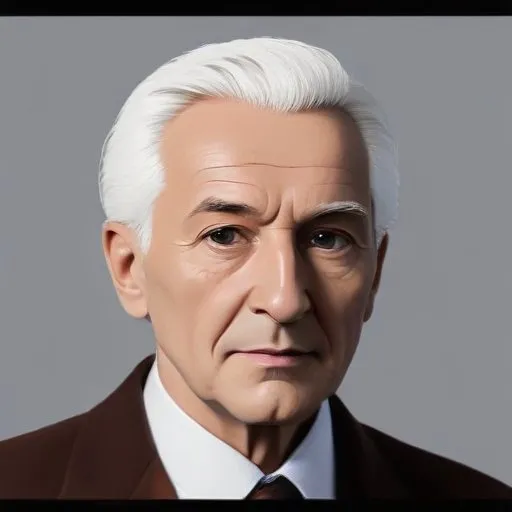
A Polish-French author and playwright, known for his absurdist and satirical works that critique social and political norms, often incorporating humor and irony. His plays and stories are celebrated for their unique blend of wit and philosophical depth.
Sawomir Mroek, a Polish dramatist, writer, and cartoonist, is best known for his absurdist plays that mocked the communist regime in Poland during the Stalinist era. His unconventional and provocative works continue to inspire controversy and debate among critics and audiences alike.
Born on June 29, 1930, in Poland, Mroek grew up in Krakow during World War II. He completed his high school education in 1949 and began his writing career as a political journalist, publishing his work in the magazine Przekrój. In 1952, he joined the government-run Writers' House ZLP, where he wrote propaganda articles supporting the communist government.
In the 1950s, Mroek began writing plays that challenged the ruling communist ideology. His absurdist style, characterized by non-realistic elements, political and historic references, distortion, and parody, aimed to shock the audience and subvert the official narrative. These plays not only reflected his disillusionment with the communist regime but also mocked its absurdity and hypocrisy.
In 1963, Mroek defected to Italy with his wife, Maria Obremba, and later moved to France and Mexico. During his exile, he continued to write plays, critiquing the communist regime and the totalitarian society it created.
In 1996, Mroek returned to Poland and settled in Krakow, where he continued to write and engage in public debates. He passed away on August 15, 2013, at the age of 83, leaving behind a body of work that remains both provocative and thought-provoking.
Mroek's works were not without controversy. His open letter supporting the persecution of Catholic priests and his later criticism of the communist regime earned him both admiration and scorn. Some critics accused him of being a former Stalinist hackwriter who turned against the regime, while others hailed him as a courageous dissident who risked his life to speak truth to power.
Mroek's absurdist plays not only influenced Polish literature but also resonated with writers and artists across the Eastern Bloc. His works continue to inspire new generations of writers, directors, and artists who seek to challenge the status quo and push the boundaries of creative expression.
"I write not to please the audience, but to disturb them, to make them think, to make them angry, to make them laugh. I write to shock them out of their complacency."
Sawomir Mroek's legacy extends beyond his plays and writings. He represents a generation of Polish intellectuals who dared to challenge the communist regime and its ideology. His courage, his creativity, and his commitment to artistic freedom continue to inspire and influence writers, artists, and activists around the world.
Born in 1921
A Polish poet and playwright who explored the human condition, morality, and the absurdity of life through his avant-garde works, often blending poetry and drama.
Born in 1904
A Polish literary mastermind, celebrated for his avant-garde novels and plays that probed the human condition, identity, and the search for meaning. His works are a blend of philosophical inquiry, psychological insight, and dark humor.
Born in 1911
A Polish writer and intellectual who explored the human condition, morality, and politics through his novels, essays, and poetry, earning him the Nobel Prize in Literature.
Born in 1923
A Polish poet and translator who captured the human experience through subtle, introspective verse, earning her the Nobel Prize in Literature. Her poetry explores the complexities of life, love, and mortality.
Born in 1921
A renowned science fiction author and philosopher who explored the intersection of humanity and technology, creating thought-provoking works that blend satire, humor, and social commentary.
Born in 1926
A renowned filmmaker behind iconic Polish New Wave cinema, known for powerful, poignant, and visually stunning works that often explored Poland's complex history and identity.
