


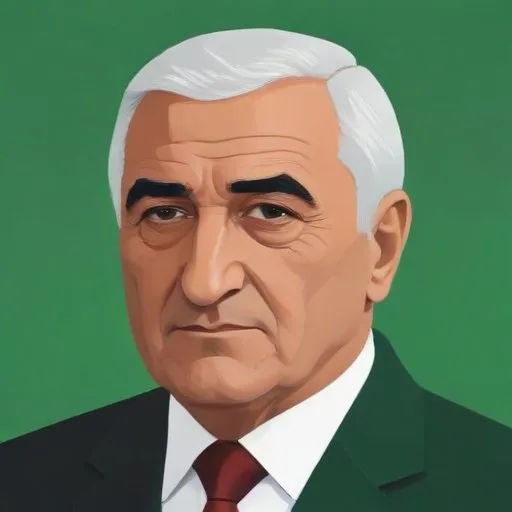
The 2nd President of Abkhazia, a disputed region in Georgia, who led the country from 2005 to 2011 and played a key role in its separatist movement. He's known for his efforts to gain international recognition for Abkhazia's independence.
Sergei Bagapsh, the second President of Abkhazia, is known for guiding his nation towards independence and recognition on the international stage. Through his leadership, Abkhazia gained recognition from Russia in 2008, a milestone that marked a significant turning point in the country's history.
Born on March 4, 1949, in Sukhumi, Abkhazia, Bagapsh's early life was marked by a strong sense of national identity and a desire to promote Abkhazian interests. Following the dissolution of the Soviet Union, he ventured into business, becoming a successful entrepreneur and representative of Abkhazian interests in Russia.
In 1997, Bagapsh assumed the role of Prime Minister of Abkhazia, overseeing a brief but successful war with Georgia. During his tenure, he navigated the country through a period of high tension and displacement, eventually securing the return of 30,000 Georgian civilians.
In 2004, Bagapsh founded the United Abkhazia party, opposing then-President Vladislav Ardzinba's government. He ran for President against Raul Khajimba, Ardzinba's choice, and initially seemed poised to lose. However, the Supreme Court of Abkhazia declared Bagapsh the winner, sparking a political crisis and protests from both sides. Eventually, Bagapsh and Khajimba formed a national unity ticket, with Bagapsh becoming President and Khajimba taking on the role of Vice President in 2005.
As President, Bagapsh single-mindedly pursued international recognition for Abkhazia. His efforts culminated in 2008, when Russia recognized Abkhazia's independence following the Russo-Georgian War. This breakthrough paved the way for significant investment from Russian businesses, as well as pressure to privatize assets, drawing both support and criticism.
Bagapsh successfully secured a second term as President in 2009, defeating Khajimba once again. Throughout his presidency, he remained committed to consolidating Abkhazia's independence and strengthening its position on the global stage.
On May 29, 2011, Bagapsh passed away due to complications from surgery to remove cancerous growths on his lung. His legacy as a champion of Abkhazian independence and self-determination continues to inspire generations in Abkhazia and beyond.
Sergei Bagapsh's unwavering commitment to his nation's independence and sovereignty has left an indelible mark on Abkhazia's history. His leadership and vision continue to shape the country's future, inspiring future generations to build upon his legacy.
87 Years Old
Ukraine's second president, an engineer-turned-politician, known for navigating the country's post-Soviet transition and implementing economic reforms. He's also infamous for his alleged role in a journalist's murder.
98 Years Old
A Georgian politician who served as the country's second president, known for his role in ending the Cold War and introducing democratic reforms to Georgia.
95 Years Old
The last leader of the Soviet Union, who introduced reforms that led to the end of the Cold War and the collapse of communism, earning a Nobel Peace Prize. He's known for his policies of glasnost and perestroika, which transformed the Soviet Union and the world.
73 Years Old
A Russian politician who has dominated the country's politics for over two decades, known for his authoritarian leadership style and controversial foreign policy decisions.
