


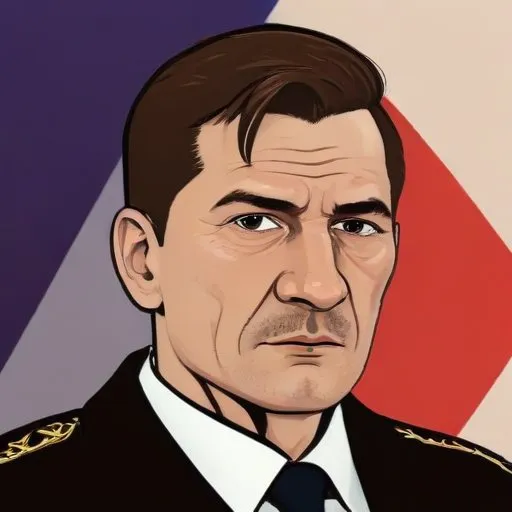
A former KGB agent who defected to the West, exposing Soviet espionage tactics and revealing the inner workings of the KGB. Known for his daring escape and subsequent testimony.
Sergei Kourdakov, a self-described former KGB agent and Soviet Navy officer, is known for his alleged involvement in over 150 raids on underground Christian communities in the Soviet Union during the 1960s. His dramatic defection to Canada, where he converted to Evangelical Christianity, and his subsequent autobiography, The Persecutor, have made him a figure of both fascination and controversy.
Born on March 1, 1951, in Novosibirsk Oblast, Soviet Union, Kourdakov's early life was shaped by his father, Nikolai Ivanovich Kourdakov, a soldier in the Soviet Army and a loyal supporter of Joseph Stalin. His father's military career and political activism had a significant impact on Sergei's worldview and future actions.
Kourdakov's involvement with the KGB and Soviet Navy led him to participate in numerous raids on underground Christian communities across the Soviet Union. These actions, which he later claimed to have been motivated by a desire to prove himself to his father, had a profound impact on the lives of countless individuals and families.
At the age of twenty, Kourdakov defected to Canada by jumping from a naval trawler into the Pacific Ocean and swimming ashore to Haida Gwaii. It was during this time that he converted to Evangelical Christianity, a decision that would shape his future writings and public persona.
Kourdakov's autobiography, The Persecutor, was written shortly before his death in 1973 and published posthumously. The book details his alleged involvement with the KGB and his subsequent conversion to Christianity. However, the book's authenticity has been called into question by some, including American Evangelical Christian journalist and filmmaker Caroline Walker, who travelled to Russia to verify Kourdakov's claims.
Walker's research trip to Russia led to a documentary film, Forgive Me, Sergei, which won numerous awards worldwide. The documentary raises questions about the validity of Kourdakov's autobiography, suggesting that it may have been fabricated to gain political asylum in Canada and to build a lucrative career as an Evangelical author and public speaker.
Kourdakov's story, regardless of its authenticity, has had a significant impact on the Evangelical Christian community and beyond. His autobiography has been widely read and has sparked important discussions about persecution, faith, and redemption. While controversies surrounding his life and writings continue to emerge, Kourdakov's legacy remains a complex and fascinating topic of exploration.
Born in 1914
Leader of the Soviet Union from 1982 to 1984, known for attempting to reform the stagnant Soviet economy and crack down on corruption. Implemented policies to increase discipline and productivity.
Born in 1911
The last Soviet leader before Mikhail Gorbachev, he briefly ruled the USSR from 1984 to 1985, maintaining a hardline communist stance and resisting reform.
95 Years Old
The last leader of the Soviet Union, who introduced reforms that led to the end of the Cold War and the collapse of communism, earning a Nobel Peace Prize. He's known for his policies of glasnost and perestroika, which transformed the Soviet Union and the world.
Born in 1906
A Soviet leader who ruled with an iron fist, implementing policies that stagnated the economy and suppressed dissent, while also being a key figure in the Cold War. He's infamous for his authoritarian regime and bureaucratic inefficiency.
Born in 1909
Soviet Minister of Foreign Affairs who played a crucial role in shaping the country's foreign policy during the Cold War, known for his diplomatic skills and ability to navigate complex international relations.
