


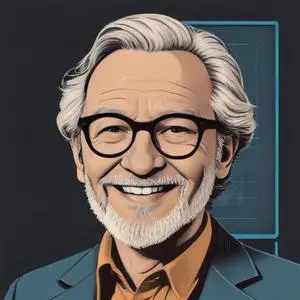
Co-creator of the Logo programming language, which introduced children to coding and revolutionized computer education. Known for his work in artificial intelligence and child-centered learning.
Seymour Papert is renowned for pioneering artificial intelligence and constructionism, a revolutionary approach to education that emphasized hands-on learning and creativity. As the co-inventor of the Logo programming language, Papert's work had a profound impact on the way we understand and interact with technology.
Born on February 29, 1928, in Pretoria, South Africa, Papert grew up in a Jewish family and developed an early passion for mathematics. He pursued his Bachelor of Arts degree in philosophy at the University of the Witwatersrand, graduating in 1949. Papert then went on to earn his PhD in mathematics from the same institution in 1952.
He further enriched his academic credentials by earning a second doctorate in mathematics from the University of Cambridge in 1959, under the supervision of Frank Smithies. This marked the beginning of Papert's remarkable journey in the realms of mathematics, computer science, and education.
Papert's illustrious career spanned across various prestigious institutions, including St. John's College, Cambridge, the Henri Poincaré Institute at the University of Paris, the University of Geneva, and the National Physical Laboratory in London. He eventually joined MIT in 1963 as a research associate, where he remained until 1967.
In 1967, Papert became a professor of applied mathematics and co-director of the MIT Artificial Intelligence Laboratory, alongside Professor Marvin Minsky. This collaboration led to the development of the Logo programming language, designed to introduce children to programming concepts.
From 1974 to 1981, Papert also held the position of Cecil and Ida Green Professor of Education at MIT, where he founded the Epistemology and Learning Research Group at the MIT Architecture Machine Group, which later evolved into the MIT Media Lab.
Papert's work was deeply rooted in the constructivist learning theories of Jean Piaget, with whom he worked at the University of Geneva from 1958 to 1963. He expanded upon Piaget's ideas, developing the theory of constructionism, which emphasized the importance of hands-on learning experiences and creativity in the educational process.
Papert believed that children learn best through active participation, construction, and self-discovery, rather than mere instruction or rote memorization. His constructionist approach has had a lasting impact on education, encouraging a shift from traditional teaching methods towards more interactive and student-centered approaches.
Papert's work has far-reaching implications for modern society, from artificial intelligence to education and beyond. His constructionist approach has inspired a new wave of educational reform, emphasizing the importance of STEM education and hands-on learning experiences.
The Logo programming language, co-invented by Papert, has enabled children to explore the world of computer programming, fostering a new generation of innovators and thinkers. Papert's legacy continues to shape the way we think about education, technology, and their interconnectedness.
Throughout his career, Papert received numerous awards and honors, including the Marconi Award, the Harold W. McGraw Jr. Prize in Education, and the National Science Foundation's Distinguished Teaching Scholars Award.
Papert's personal life was marked by a passion for learning and exploration. He was known for his warm and humble demeanor, which earned him the respect and admiration of his peers and students alike.
In 2016, Papert passed away on July 31, leaving behind a rich legacy that continues to inspire and educate generations to come. His work remains an enduring testament to the power of innovative thinking, creativity, and dedication to the betterment of education and humanity.
98 Years Old
Pioneering computer scientist and academic who coined the term "Artificial Intelligence" and made significant contributions to the development of AI, time-sharing systems, and Lisp programming language.
Born in 1912
Pioneering mathematician and computer scientist who cracked the German Enigma code during WWII and laid the foundations for modern computer science and artificial intelligence.
Born in 1906
A groundbreaking logician and philosopher who shook the foundations of mathematics with his incompleteness theorems, proving that no formal system can be both complete and consistent.
Born in 1925
A pioneer in human-computer interaction, he revolutionized personal computing by inventing the mouse, enabling intuitive navigation and transforming the way we interact with technology.
89 Years Old
Developer of the concept of hypertext, which allows users to navigate and link digital information in a non-linear fashion, revolutionizing the way we interact with computers and access knowledge.
88 Years Old
Developed Sketchpad, a pioneering computer-aided design (CAD) system, and invented the virtual reality (VR) head-mounted display.
72 Years Old
Irish guitarist and songwriter, founding member of The Boomtown Rats, known for hits like "I Don't Like Mondays" and "Rat Trap".
