


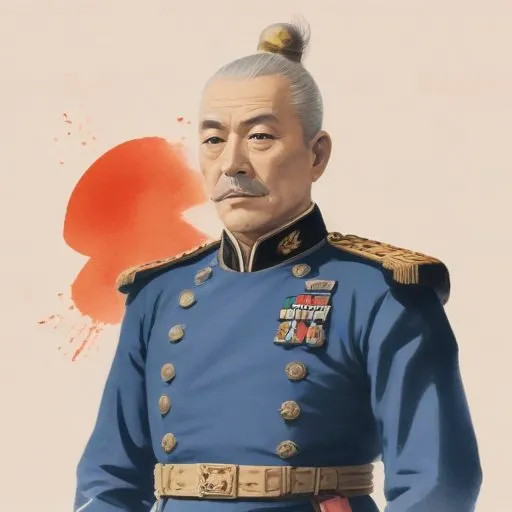
A skilled Japanese general who led his clan to several victories during the Sengoku period, known for his bravery and clever tactics.
Known for his unwavering bravery and exceptional military prowess, Shimazu Yoshihiro was a Japanese daimyō who greatly contributed to the unification of Kyushu during the tumultuous Sengoku period. As a skilled general, he played a crucial role in several battles, earning recognition as one of the most formidable warriors of his time.
Born on August 21, 1535, at Izaku Castle, Shimazu Yoshihiro was the second son of Shimazu Takahisa and the younger brother of Shimazu Yoshihisa. From an early age, he demonstrated exceptional leadership skills, eventually becoming the castle lord in command of Iino Castle.
In 1572, Yoshihiro, alongside Niiro Tadamoto, defeated the It clan at the Battle of Kizaki, showcasing his military prowess. He continued to prove himself in subsequent battles, including the Battle of Mimigawa in 1578, where he helped defeat the Otomo clan alongside his brothers.
In 1587, facing Toyotomi Hideyoshi's troops, Yoshihiro pressed for war even after his brother and clan head Yoshihisa surrendered. However, he eventually accepted his brother's request to surrender, recognizing the futility of further resistance.
Under Hideyoshi's command, Yoshihiro participated in the Seven-Year War, leading Japanese forces on the Korean peninsula in 1592 and 1597. During this campaign, he collaborated with other skilled generals, including Tōdō Takatora, Katō Yoshiaki, and Konishi Yukinaga, to achieve several victories.
One of his most notable achievements during this period was his victory at the Battle of Sacheon in 1598, where he defeated a Ming army of 37,000 soldiers with only 7,000 troops under his command.
After Toyotomi Hideyoshi's death in 1598, Yoshihiro fought for the Western Army at the Battle of Sekigahara, one of the most pivotal battles in Japanese history. Despite being on the losing side, he managed to rescue Japanese commanders and return to Japan.
Yoshihiro's later life was marked by his continued influence as a respected daimyō. He played a significant role in the Shimazu clan's affairs, ensuring the clan's prosperity and stability in the years following the Battle of Sekigahara.
Shimazu Yoshihiro's unwavering dedication to his clan and his unrelenting spirit in the face of adversity have made him an iconic figure in Japanese history. His military achievements and leadership skills have inspired generations of Japanese warriors, cementing his place as one of the most revered daimyō of the Sengoku period.
Through his remarkable life and achievements, Shimazu Yoshihiro has left an indelible mark on Japanese history, serving as a testament to the power of courage, perseverance, and loyalty.
Born in 1537
A powerful Japanese warlord who unified Japan's warring states and led two invasions of Korea, leaving a lasting legacy in Japanese history. He's also known for his iconic Osaka Castle.
Born in 1543
Unified Japan's warring states, establishing a dynasty that ruled for over 250 years, and is revered as a brilliant military strategist and statesman.
Born in 1530
A powerful feudal lord who unified Japan's Echigo Province and fought several battles, earning a legendary reputation for bravery and martial prowess.
Born in 1521
A powerful daimy? who unified Japan's Takeda clan and expanded its territories through military campaigns, known for his exceptional leadership and innovative tactics.
Born in 1567
A powerful feudal lord who unified Japan's northern regions and was known for his distinctive crescent-moon helmet and military prowess. He played a crucial role in Japan's unification under the Tokugawa shogunate.
