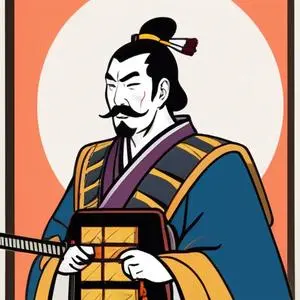
Toyotomi Hideyoshi: The Second Great Unifier of Japan
A Humble Beginning to a Legendary Legacy
Toyotomi Hideyoshi, a Japanese samurai and daimyō, is renowned as the second Great Unifier of Japan, a title he earned by unifying the warring states of Japan's Sengoku period. His rise to power, from a peasant background to the highest official position in the nobility class, is a testament to his cunning, strategic prowess, and unwavering ambition.
Rise to Prominence
Born on March 17, 1537, Hideyoshi began his career as a retainer of the prominent lord
Oda Nobunaga. He quickly rose through the ranks, earning the respect and trust of Nobunaga, who saw potential in the young samurai. After Nobunaga's assassination in 1582, Hideyoshi succeeded him and continued his campaign to unify Japan, ultimately becoming the de facto leader of the country.
Unification and Reforms
Hideyoshi's unification campaign was marked by his innovative tactics, including the use of guns, which allowed him to defeat his enemies and consolidate power. He implemented various reforms, such as the Taiko Kenchi, a nationwide land survey that aimed to redistribute land and create a more equitable taxation system. This reform boosted Hideyoshi's popularity among the people and solidified his position as the ruler of Japan.
titles and Positions
Throughout his career, Hideyoshi held various prestigious titles, including Kampaku (Imperial Regent) and Daijdaijin (Chancellor of the Realm), the highest official position in the nobility class. He was the first person in history to become a Kampaku who was not born a noble, a testament to his remarkable rise to power.
Japanese Invasions of Korea
In 1592, Hideyoshi launched the Japanese invasions of Korea, aiming to expand Japan's borders and secure resources. Although the initial campaigns were successful, the war eventually stagnated, damaging his prestige and weakening his hold on power.
Legacy and Death
Toyotomi Hideyoshi passed away on September 18, 1598, leaving behind a complex and tumultuous legacy. His son,
Toyotomi Hideyori, succeeded him, but was ultimately displaced by
Tokugawa Ieyasu at the Battle of Sekigahara in 1600, marking the beginning of the Tokugawa Shogunate era.
Personal Milestones and Key Life Events
- Born on March 17, 1537, in Nakamura, Owari Province, Japan
- Became a retainer of Oda Nobunaga in 1558
- Succeeded Oda Nobunaga as the ruler of Japan in 1582
- Launched the Japanese invasions of Korea in 1592
- Passed away on September 18, 1598, at Fushimi Castle, Kyoto, Japan
Influence on Modern Society
Toyotomi Hideyoshi's legacy extends far beyond his military conquests and reforms. He played a significant role in shaping Japan's modern society, economy, and culture. His policies and innovations paved the way for Japan's rapid modernization in the centuries that followed.
Philosophical Contributions and Beliefs
Hideyoshi's philosophy was deeply rooted in Confucianism and Buddhism, which influenced his governance and decision-making processes. He believed in the importance of education, meritocracy, and social mobility, reflecting his own rise from humble beginnings to greatness.
Trivia and Fun Facts
- Hideyoshi was known for his short stature, earning him the nickname " monkey"
- He was a skilled tea master and appreciated the art of Chanoyu, the Japanese tea ceremony
- Hideyoshi built Osaka Castle, one of Japan's most famous landmarks, in 1583
Historical Context and Legacy
Toyotomi Hideyoshi's life and reign were marked by turmoil and transformation. His unification of Japan and subsequent reforms laid the groundwork for the country's modernization and emergence as a major world power. His legacy continues to inspire and fascinate, offering valuable lessons in leadership, strategy, and statecraft.
FAQ
What were Toyotomi Hideyoshis military achievements?
Toyotomi Hideyoshi was a brilliant military strategist who unified Japan, conquering numerous provinces and establishing a strong centralized government. He also led two invasions of Korea.
How did Hideyoshis rule impact Japanese society?
Hideyoshis rule brought stability and prosperity to Japan, promoting economic growth, trade, and cultural development. He also implemented policies to reduce the power of the daimyō and increase the authority of the central government.
What was Hideyoshis role in the construction of Osaka Castle?
Hideyoshi built Osaka Castle, one of Japans most famous landmarks, as a symbol of his power and to consolidate his control over western Japan.
What led to Hideyoshis decision to invade Korea?
Hideyoshis desire to expand Japanese influence, secure trade routes, and spread Buddhism led him to launch two invasions of Korea, known as the Imjin War.
What is Hideyoshis place in Japanese history?
Toyotomi Hideyoshi is remembered as one of Japans greatest military leaders, unifiers, and rulers. His legacy continues to shape Japanese politics, culture, and identity today.