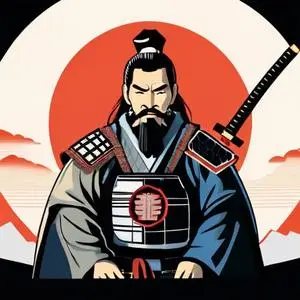
Tokugawa Ieyasu: The Founder of the Tokugawa Shogunate
A Unifier of Japan
Tokugawa Ieyasu is renowned as the founder and first shogun of the Tokugawa shogunate, which dominated Japan from 1603 to 1868. He is credited as one of the three Great Unifiers of Japan, alongside his former lord
Oda Nobunaga and fellow Oda subordinate Toyotomi Hideyoshi.
Early Life and Rise to Power
Ieyasu was born Matsudaira Takechiyo on January 31, 1543, in Okazaki Castle. His father, Matsudaira Hirotada, was a minor daimyo of Mikawa, and his mother, Odai no Kata, was the daughter of a neighboring samurai lord, Mizuno Tadamasa. As a child, Ieyasu was sent as a hostage to the Imagawa clan, where he lived under the patronage of daimyo Imagawa Yoshimoto. After his father's death, Ieyasu succeeded as daimyo and went on to serve as an ally, vassal, and general of the Oda clan.
Military Campaigns and Alliances
Ieyasu's military prowess and strategic alliances played a significant role in his rise to power. He fought alongside Oda Nobunaga in several battles, including the Battle of Anegawa in 1568. After Nobunaga's death, Ieyasu briefly rivalled
Toyotomi Hideyoshi, but eventually declared his allegiance to Hideyoshi and fought on his behalf. Under Hideyoshi, Ieyasu was relocated to the Kanto plains in eastern Japan, where he built his castle in the fishing village of Edo (now Tokyo).
The Battle of Sekigahara and the Establishment of the Tokugawa Shogunate
After Hideyoshi's death, Ieyasu seized power in 1600, following the Battle of Sekigahara. This decisive victory cemented his position as the most powerful daimyo in Japan. In 1603, he received the appointment as shogun, marking the beginning of the Tokugawa shogunate. Although he voluntarily resigned from his position in 1605, Ieyasu maintained de facto control of the government until his death in 1616.
The Bakuhan System and Legacy
Ieyasu implemented a set of careful rules known as the bakuhan system, designed to keep the daimyo and samurai in check under the Tokugawa Shogunate. This system ensured the Tokugawa clan's dominance for over 250 years, until the Meiji Restoration in 1868. Ieyasu's legacy extends beyond his political accomplishments, as he is also remembered for his cultural contributions, including the promotion of Neo-Confucianism and the development of Japanese art and literature.
Personal Characteristics and Quotes
Ieyasu was known for his intelligence, strategic thinking, and strong leadership. He is often quoted as saying, "The strong manly ones in life are those who understand the meaning of the word patience." Another famous quote attributed to him is, "Life is like unto a long journey with a heavy burden. Let thy step be slow and deliberate, that thou mayest pendant not upon the way."
Impact on Modern Society
Tokugawa Ieyasu's legacy continues to shape modern Japanese society. His cultural and political reforms laid the groundwork for Japan's rapid modernization in the 19th century. The Tokugawa shogunate's emphasis on education, social hierarchy, and Confucian values remains influential in contemporary Japanese culture.
Conclusion
Tokugawa Ieyasu's remarkable life and achievements have left an indelible mark on Japanese history. As a unifier, military strategist, and visionary leader, he transformed Japan into a unified and prosperous nation, setting the stage for its emergence as a global power in the centuries to come.
FAQ
What was Tokugawa Ieyasus role in Japanese history?
Tokugawa Ieyasu was a Japanese shōgun who played a crucial role in unifying Japan and establishing the Tokugawa shogunate, which ruled the country for over 250 years.
What were Ieyasus achievements as shōgun?
Ieyasu established a strong and stable government, created a new capital in Edo (now Tokyo), and promoted trade and cultural exchange with foreign countries, including the Netherlands and China.
What was Ieyasus relationship with the imperial court?
Ieyasu maintained a close but complex relationship with the imperial court, acknowledging the emperors authority while also consolidating his own power as shōgun.
How did Ieyasu come to power?
Ieyasu came to power after defeating his rivals at the Battle of Sekigahara in 1600 and was appointed shōgun by the emperor in 1603.
What was Ieyasus legacy after his death?
After his death, Ieyasu was deified as a Shinto deity and his legacy as a unifier and statesman continued to shape Japanese politics and culture for centuries.