


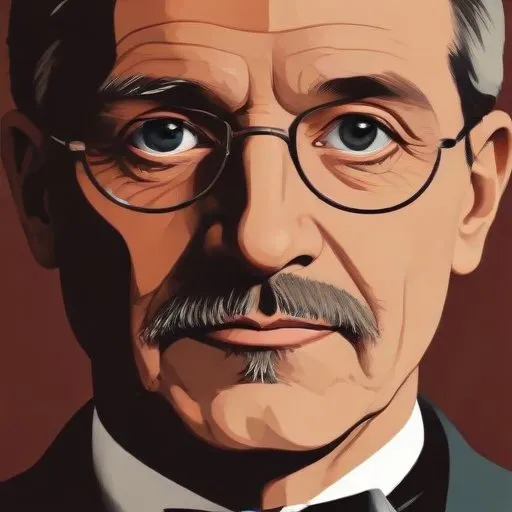
Pioneering researcher of the human visual system, discovering the Exner's spot, a blind spot in the retina, and making significant contributions to the field of physiology.
Sigmund Exner, an Austrian physiologist born in Vienna in 1846, is renowned for his groundbreaking work in comparative physiology and perception psychology from a physiological standpoint. His research on the functional architecture of the visual cortex, localization of behavioral functionality in the brain, and the physiology of the compound eye in insects and crustaceans has left an indelible mark on the scientific community.
Exner studied under Ernst Wilhelm von Brücke and Hermann von Helmholtz, two prominent physiologists of the time, in Vienna and Heidelberg respectively. He received his degree in 1870 and worked as an assistant in the physiological institute at the University of Vienna before succeeding Ernst von Brücke as professor of physiology and director of the physiological institute in 1891.
Exner's research on the compound eye led to the publication of Die Physiologie der facettierten Augen von Krebsen und Insekten in 1891, a seminal work that described the intricate workings of the compound eye in insects and crustaceans. His studies on color contrast, hue adaptation, apparent motion, and the sensitivity of retinal regeneration have significantly advanced our understanding of visual perception.
In addition to his work on the compound eye, Exner co-founded the Phonogrammarchiv in Vienna in 1899, an archive dedicated to recording acoustic phenomena for scientific purposes.
Exner received honorary doctorates from the Universities of Leipzig and Athens in recognition of his outstanding contributions to the field of physiology.
Sigmund Exner came from a family of distinguished academics. His father, Franz Serafin Exner, was a philosopher, and his brothers, Adolf Exner, Karl Exner, and Franz Exner, were a law professor, physicist, and physicist respectively. His sister, Marie, was married to urologist Anton von Frisch.
The term "Call-Exner bodies" is associated with Sigmund Exner, named in conjunction with American physician Emma Louise Call. These small spaces filled with eosinophilic fluid and basement membrane material are typically associated with granulosa cell tumors.
Exner's work on the compound eye and visual perception has far-reaching implications for fields such as robotics, computer vision, and optometry. His research has paved the way for the development of more advanced technologies and has deepened our understanding of the intricacies of human perception.
In conclusion, Sigmund Exner's pioneering work in physiology has left an indelible mark on the scientific community, and his contributions continue to inspire and influence researchers to this day.
Born in 1849
A Russian physiologist and physician who discovered the concept of classical conditioning, where he demonstrated that animals can learn to associate stimuli with a particular response, revolutionizing our understanding of behavior. His work laid the foundation for behavioral psychology and continues to influence fields like education and advertising.
Born in 1852
Pioneering neuroscientist and pathologist who discovered the structure of neurons and pioneered the field of neuroscience, earning a Nobel Prize in Physiology or Medicine in 1906.
Born in 1843
Italian physician and pathologist who discovered the Golgi apparatus, a complex organelle found in cells, and developed a staining technique to visualize it. His work revolutionized the field of cell biology.
Born in 1857
A pioneering scientist who made groundbreaking discoveries in the fields of physiology, bacteriology, and pathology, and was awarded the Nobel Prize for his work on the nervous system.
Born in 1873
A pioneering scientist who discovered the chemical transmission of nerve impulses, revolutionizing our understanding of the nervous system. His groundbreaking work earned him a Nobel Prize in Physiology or Medicine in 1936.
Born in 1886
This Nobel Prize-winning scientist is renowned for his groundbreaking research on animal behavior, particularly bee communication, and his discovery of the waggle dance.
Born in 1903
A renowned expert in animal behavior, he pioneered the study of instinct and imprinting, and is famous for his work on aggression and his book "On Aggression".
Born in 1899
A Hungarian-American biophysicist and academic who discovered the mechanisms of hearing and balance, earning him a Nobel Prize in Physiology or Medicine in 1961. His work revolutionized our understanding of the human ear and its functions.
