


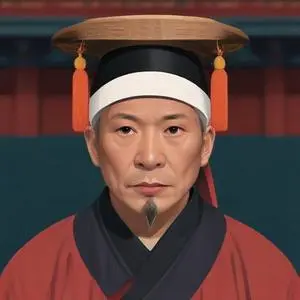
A renowned historian and statesman who compiled the comprehensive history of China, "Zizhi Tongjian", a monumental work of 294 volumes that remains a valuable resource for Chinese historians.
Known for his monumental work, the Zizhi Tongjian, a comprehensive history of China that spans over 1,300 years, Sima Guang is revered as one of the most influential historians and politicians of the Song Dynasty. His contributions to Chinese historiography and politics have made him a household name, leaving an indelible mark on the country's intellectual and cultural heritage.
Born on November 17, 1019, in Guang Prefecture, Sima Guang was named after his birthplace, where his father, Sima Chi, served as a county magistrate. The Sima family claimed descent from the 3rd-century Cao Wei official Sima Fu and was known for their intellectual prowess.
A famous anecdote from Sima's childhood tells the story of his bravery and quick thinking. When a playmate fell into a massive vat of water, Sima calmly picked up a rock and smashed a hole in the base of the pot, saving his friend's life. This incident not only demonstrated his courage but also foreshadowed his future as a brilliant strategist.
Sima Guang's love for learning was evident from an early age. At six, he was fascinated by a lecture on the Zuo Zhuan, a 4th-century BC work of history, and could retell the stories to his family with remarkable accuracy. His dedication to reading and learning earned him recognition as a child prodigy.
At barely twenty, Sima passed the Imperial examination with the highest rank of jnsh, metropolitan graduate, and began his career as a scholar-official. Over the next several years, he held various official positions, refining his skills as a historian, politician, and writer.
Sima Guang was a staunch conservative who believed that civilization was created when the sage kings transformed humans from their original animal state using hierarchical order, property rights, moral instruction, and penal law. He argued that the problem with government lay not in its structure but in the people who ran it.
He wrote multiple memorials detailing how to make the government more effective, emphasizing the importance of history as a guide for governance. Sima's views were in stark contrast to those of Wang Anshi, who emphasized the Classics and the role of Heaven and Earth in shaping human destiny.
Sima Guang's magnum opus, the Zizhi Tongjian, is a testament to his dedication to historiography. This comprehensive history of China covers the period from 403 BCE to 959 CE, providing invaluable insights into the country's political, social, and cultural evolution.
His work has had a profound impact on Chinese historiography, influencing generations of historians and scholars. Sima's emphasis on the importance of understanding history in governance has made him a revered figure in Chinese politics and intellectual circles.
In conclusion, Sima Guang's remarkable life and works have left an enduring legacy in Chinese history and politics. His contributions to historiography, philosophy, and politics continue to inspire and influence scholars, policymakers, and intellectuals to this day.
Born in 1021
A pioneering economist and reformer who introduced groundbreaking policies to stabilize the economy and reduce poverty in 11th-century China, leaving a lasting legacy in Chinese history.
Born in 1130
A leading figure in Confucianism, he synthesized Confucian classics into a coherent philosophical system, influencing East Asian thought for centuries. His teachings emphasized moral cultivation and self-reflection.
Born in 1048
Ruling China from 1067 to 1085, he implemented reforms to strengthen the economy and military, and his diplomatic efforts led to a period of peace with neighboring countries.
