


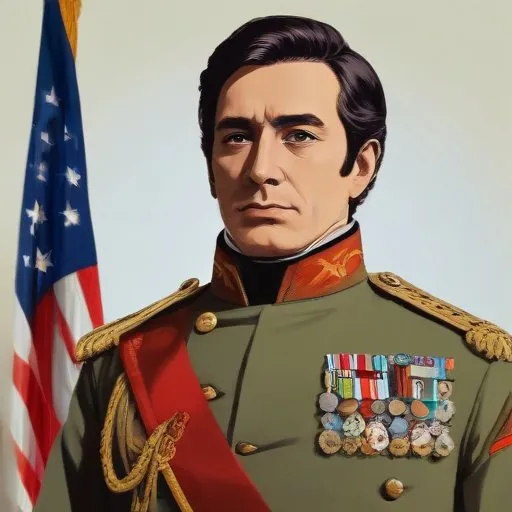
American general who led the defense of the Philippines during World War II, ultimately surrendering to Japanese forces in 1942. He was a prominent military leader in the Pacific Theater.
Simon Bolivar Buckner Jr. is etched in history as one of the highest-ranking United States military officers to lose his life to enemy fire during World War II. As a lieutenant general, he led American-Canadian forces in the Aleutian Islands campaign, orchestrating the Battle of Attu and the Kiska Expedition, and later commanded the Tenth Army in the amphibious invasion of the Japanese island of Okinawa.
Buckner's early life was marked by the influences of his father, Confederate general Simon Bolivar Buckner, and his wife Delia Hayes Claiborne. He was named after the Venezuelan soldier and statesman Simón Bolívar, who led several countries to independence from the Spanish Empire. Raised near Munfordville, Kentucky, Buckner accompanied his father on his 1896 presidential campaign, where he served as the running mate of ex-Union general John M. Palmer.
Buckner attended the Virginia Military Institute before enrolling at West Point, where he graduated in 1908. He went on to serve in various military capacities, including as a military attaché in Tokyo, Japan, and as the commander of the 6th Infantry Regiment during World War I.
In 1945, Buckner took command of the Tenth Army, leading the amphibious invasion of Okinawa, Japan. The grueling battle lasted for 83 days, during which Buckner's forces faced fierce resistance from Japanese troops. Tragically, Buckner was killed on June 18, 1945, by enemy artillery fire, just a few days before the battle's conclusion.
Buckner's sacrifice and bravery were recognized by the US government, which posthumously promoted him to four-star general on July 19, 1954, by a Special Act of Congress. He was also awarded the Distinguished Service Cross, the Silver Star, and the Purple Heart, among other honors.
Buckner's life was marked by significant personal milestones, including his marriage to Adele Blanc Buckner in 1916 and the birth of their two children, Simon Bolivar Buckner III and Mary Blanc Buckner.
Buckner's contributions to the Allied victory in World War II cannot be overstated. His leadership and strategic prowess played a crucial role in securing key victories in the Pacific Theater, paving the way for the eventual surrender of Japan. Today, he is remembered as a hero and a symbol of American sacrifice and bravery.
Born in 1890
Led the Allied forces to victory in World War II and later served as President, maintaining peace and prosperity during the Cold War era. He's known for his strategic leadership and diplomatic skills.
Born in 1893
Led the US Army in World War II and became the last five-star general, playing a crucial role in shaping post-war American military strategy. He's also known for his humble and unassuming leadership style.
Born in 1885
A renowned military leader who played a crucial role in World War II, particularly in the Allied victory in Europe, known for his bold tactics and unapologetic style.
Born in 1896
Led the Allied invasion of Italy during World War II, playing a crucial role in the war's Mediterranean Theater. He later became the Commander-in-Chief of the United States Army Field Forces.
Born in 1891
Led the US Air Forces to victory in World War II, pioneering the use of strategic bombing and playing a crucial role in shaping the US military's air power.
Born in 1896
Led a daring bombing raid on Tokyo in 1942, earning the Medal of Honor for his bravery and helping to turn the tide of World War II.
