


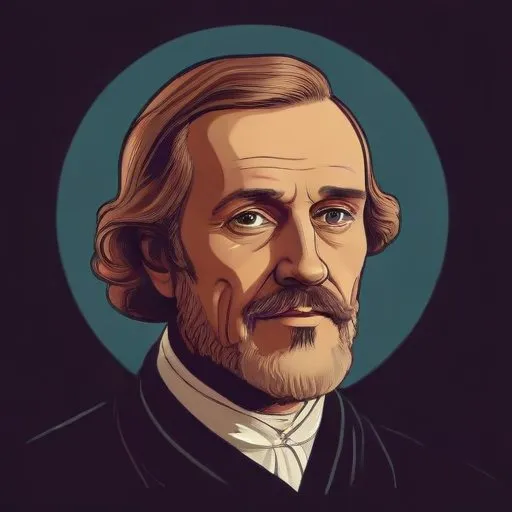
A 16th-century astronomer who discovered the four largest moons of Jupiter independently of Galileo, and also made notable contributions to the study of comets and the development of astronomical tables.
Simon Marius, a 16th-century German astronomer, is best known for being among the first observers of the four largest moons of Jupiter, a groundbreaking discovery that shook the foundations of astronomy. His publication of this finding, however, led to charges of plagiarism, casting a shadow over his remarkable achievement.
Simon Marius was born on January 10, 1573, in Gunzenhausen, near Nuremberg, Germany. His father, Reichart Mayr, was a mayor of Gunzenhausen, and Marius's early life was marked by a strong educational foundation. He was admitted to the Margraves Academy in Heilsbronn in 1586, where he studied until 1601, developing a keen interest in astronomy and mathematics.
Marius's thirst for knowledge drove him to seek out the best educational institutions of his time. He desired to attend the University of Königsberg but was unable to secure a scholarship. Instead, the Margrave wrote a letter of recommendation, allowing Marius to study under the renowned astronomer Tycho Brahe in Prague for several months in 1601.
Although Marius's time in Prague was brief, it had a profound impact on his work. He may have even worked directly with David Fabricius, a Danish astronomer, rather than Brahe himself.
In December 1601, Marius arrived in Padua to study medicine at the University of Padua. During his time in Padua, he tutored other students in astronomy, including Baldassare Capra, with whom he co-authored a book on a new star, later known as Kepler's Supernova, which they had observed in 1604.
In 1606, Marius married Felicitas Lauer, the daughter of his publisher, in Ansbach. The couple had a strong bond, which was evident in Marius's dedication to his work and his family.
Sirius, Marius's most famous work, was published in 1614, in which he presented his observations on the four largest moons of Jupiter. Although he was accused of plagiarism, Marius's discovery paved the way for future astronomers to explore the wonders of the Jupiter system.
Marius's legacy is marked by both controversy and accolades. While he was accused of stealing Galileo's discovery, his own observations and findings were groundbreaking for his time.
Sir Simon Marius may have lived centuries ago, but his work continues to influence the way we understand the universe. His pioneering spirit, passion for knowledge, and perseverance in the face of adversity serve as a testament to the power of human ingenuity.
Marius's legacy extends beyond the realm of astronomy, inspiring generations of scientists, thinkers, and explorers to reach for the stars and push the boundaries of human knowledge.
Born in 1564
Pioneering astronomer, physicist, and mathematician who played a major role in the Scientific Revolution, making key discoveries that challenged Aristotelian views and laid the foundation for modern science.
Born in 1571
A 17th-century trailblazer who discovered the three laws of planetary motion, revolutionizing our understanding of the solar system. He's also credited with being a pioneer in the field of astrology.
Born in 1546
A 16th-century astronomer who made precise measurements of the stars and planets, laying the foundation for modern astronomy. His data helped Kepler discover planetary orbits.
Born in 1473
A Renaissance-era mathematician and astronomer who proposed the heliocentric model, where the Sun is at the center of our solar system, revolutionizing our understanding of the universe.
Born in 1738
A pioneering astronomer and musician who discovered Uranus and two of its moons, and also composed symphonies and concertos.
Born in 1629
A 17th-century polymath who made groundbreaking contributions to optics, probability theory, and astronomy, including the discovery of Saturn's rings and the largest moon, Titan.
Born in 1749
Developed nebular hypothesis of the origin of the solar system and formulated Laplace's equation, a fundamental concept in mathematics and physics. He's considered the founder of celestial mechanics.
