


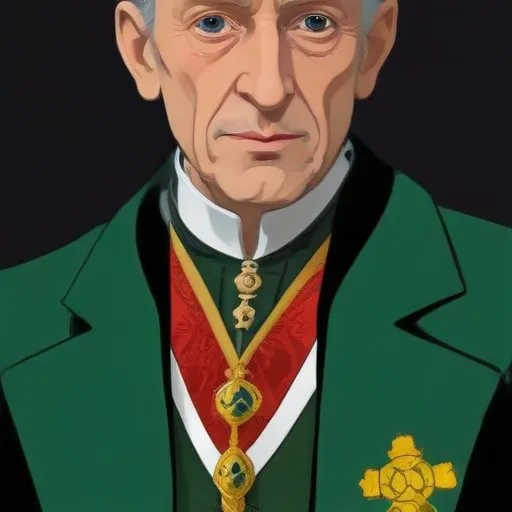
An Irish nobleman and politician who served as a Member of Parliament and was known for his advocacy of Catholic emancipation. He was also a vocal critic of the British government's treatment of Ireland.
Sir John Perceval, 1st Baronet, is renowned for his significant landholdings in Ireland and his unwavering loyalty to the Commonwealth government during the Interregnum. His dedication to the Crown earned him a baronetcy and a full pardon for his activities during the tumultuous period.
John Perceval was born on September 7, 1629, in Dublin, Ireland, to Sir Philip Perceval and Catherine Usher. He was the eldest son and heir of the Perceval family, with his grandfather, George Perceval, being a prominent figure in Irish society.
Perceval received his education at Cambridge University, where he befriended Henry Cromwell, the son of Oliver Cromwell. During his time at Cambridge, Perceval remained neutral in the English Civil War, avoiding taking sides to preserve his family's interests.
In 1649, following the execution of Charles I, Perceval returned to Ireland to protect his family's substantial landholdings. He wisely proposed to marry the daughter of William Lenthall, the Speaker of the Rump Parliament, ensuring the protection of his estates.
Perceval's strategic alliances and loyalty to the Commonwealth government earned him recognition from Henry Cromwell, who knighted him for his services to the government of Ireland. Shortly before the Restoration, Perceval held the offices of Chief Prothonotary of the Common Pleas and Clerk of the Crown.
After the Restoration, Perceval's loyalty was rewarded with a baronetcy, and he was granted a full pardon for his activities during the Interregnum. He was appointed Privy Councillor to King Charles II, a Knight of the Shire for County Cork, and a member of the Council of Trade.
Sir John Perceval, 1st Baronet, left an indelible mark on Irish history, thanks to his substantial landholdings and his unwavering loyalty to the Crown. His legacy serves as a testament to the complexities of Irish politics during the 17th century.
Sir John Perceval, 1st Baronet, passed away on November 1, 1665, leaving behind a lasting impact on Irish history and politics.
Born in 1630
The last monarch of the House of Stuart, restored to the throne after a republican Commonwealth, known for his lavish spending, mistresses, and the Great Fire of London. He ruled with a mix of absolutism and indulgence, shaping England's Restoration era.
Born in 1599
Leader of the Parliamentarian forces during the English Civil War, who later ruled England, Scotland, and Ireland as a republican dictator, known for his military victories and radical reforms.
Born in 1610
A prominent 17th-century figure who served as Lord Lieutenant of Ireland, playing a key role in Irish and British politics, while also being a respected academic and military leader. He's most known for his strategic military victories and effective governance of Ireland.
Born in 1566
A 17th-century Irish politician who served as Lord High Treasurer of Ireland, known for his extensive landholdings and economic development initiatives. He played a significant role in shaping Ireland's economy and politics during his time.
Born in 1627
Pioneering scientist who discovered Boyle's Law, which describes the relationship between pressure and volume of gases, and laid foundations for modern chemistry.
Born in 1621
A prominent military leader and politician, he played a key role in the English Civil War and later served as a governor in Ireland. He's also known for his literary works, including plays and poetry.
