


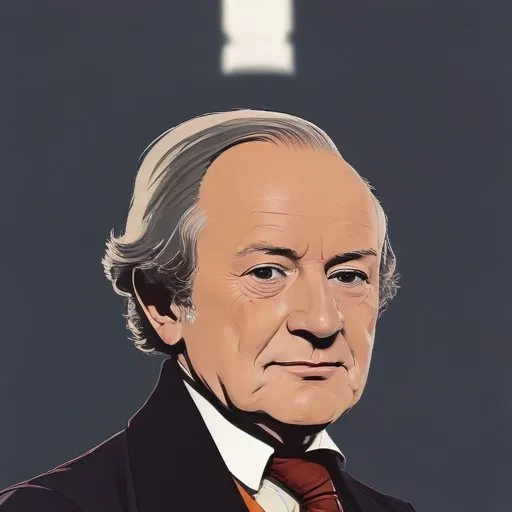
An 18th-century British politician who served as a Member of Parliament and held various government positions, known for his involvement in the abolition of slavery.
Sir John St Aubyn, 5th Baronet, was a British politician, High Sheriff of Cornwall, and Grand Master of the Freemasons, who left an indelible mark on the world of politics, geology, and beyond. Born on May 17, 1758, in London, St Aubyn's life was a testament to public service, dedication to his community, and an unwavering passion for fossil collecting.
St Aubyn was born into a family of politicians and inherited the baronetcy at the tender age of 14, following the death of his father, Sir John St Aubyn, 4th Baronet. He attended Westminster School between 1773 and 1777, where he laid the foundation for his future career in politics.
St Aubyn's career in politics spanned over three decades, during which he held various positions, including High Sheriff of Cornwall (1780), Member of Parliament for Truro (1784), Penryn (1784-1790), and Helston (1807-1812). His dedication to public service earned him the respect of his peers and the admiration of his constituents.
St Aubyn's love for fossils was more than just a hobby; it was an all-consuming passion that drove him to amass an impressive collection. He purchased the extensive collection of Richard Greene, surgeon of Lichfield, and was elected a Fellow of the Royal Society in 1797. His contributions to the field of geology continue to inspire scientists and enthusiasts alike.
St Aubyn's personal life was marked by tumultuous relationships, including a liaison with an Italian woman, which resulted in the birth of a daughter. He also had two illegitimate sons, James and Edward, the latter of whom was created a baronet in his own right in 1866. The baronetcy became extinct upon St Aubyn's death on August 10, 1839, but his legacy continues to inspire future generations.
Sir John St Aubyn, 5th Baronet, led a life that was a testament to his dedication to public service, his passion for fossil collecting, and his unwavering commitment to his community. As we reflect on his life and legacy, we are reminded of the profound impact one individual can have on the world.
Born in 1759
Prime Minister of the United Kingdom from 1783 to 1801 and 1804 to 1806, known for leading the country through the French Revolutionary and Napoleonic Wars.
Born in 1749
A prominent 18th-century politician who championed individual liberties and opposed British imperialism, known for his charismatic oratory skills and influential foreign policy decisions.
Born in 1738
The British monarch who ruled during the American Revolution, losing the colonies, and later suffered a mental illness that led to a regency crisis. He's also known for his cultural and artistic patronage.
Born in 1725
A pioneering advocate for press freedom and a vocal critic of government corruption, known for his fearless journalism and radical politics.
Born in 1729
An 18th-century thinker who shaped modern conservatism, advocating for gradual social change and warning against the dangers of radical revolution. He's also known for his philosophical writings on aesthetics and the sublime.
Born in 1712
A skilled lawyer and politician who served as Prime Minister of Great Britain, known for implementing the Stamp Act, a taxation policy that sparked American colonial resistance.
