


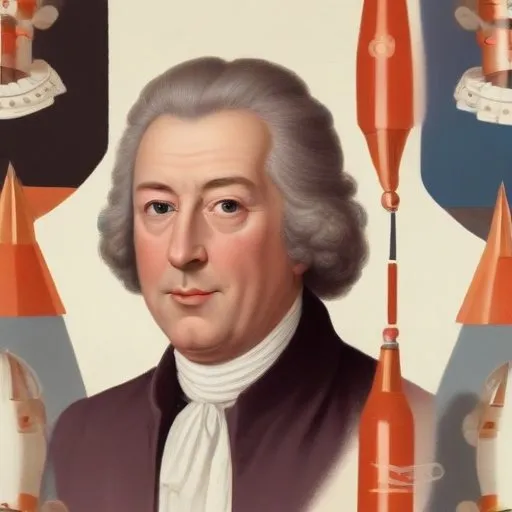
Developed early rockets that were used in warfare, particularly in the Napoleonic Wars, and held a seat in the British Parliament. Known for his innovative designs that increased rocket range and accuracy.
Sir William Congreve, 2nd Baronet, is renowned for his groundbreaking work in the field of rocket artillery, earning him a prominent place in the annals of military history. His innovative Congreve rockets, developed during the Napoleonic Wars, revolutionized warfare and left an indelible mark on the course of military technology.
Born on May 20, 1772, in Kent, England, Congreve was the eldest son of Lt. General Sir William Congreve, 1st Baronet, and Rebeca Elmston. He received his education at Newcomes school in Hackney, Wolverhampton Grammar School, and Singlewell School in Kent. He then went on to study law at Trinity College, Cambridge, graduating with a BA in 1793 and an MA in 1796.
Congreve's early career was marked by his involvement in politics and publishing. In 1803, he published a polemical newspaper, the Royal Standard and Political Register, which was Tory, pro-government, and anti-Cobbett. However, a damaging libel action in 1804 led him to withdraw from publishing and focus on inventing. This shift in direction proved to be a pivotal moment in his life, as he began experimenting with rockets at the Royal Laboratory in Woolwich.
His tireless efforts and experiments led to the development of the Congreve rocket, which was first used in combat during the Napoleonic Wars. The rocket's success can be attributed to Congreve's innovative design, which incorporated a cylindrical casing, a conical nose, and a stabilizing stick. This design enabled the rocket to fly more accurately and over longer distances, making it a game-changer on the battlefield.
Congreve's contributions to the field of rocketry did not go unnoticed. He was elected a Fellow of the Royal Society in 1811 and was awarded the honorary rank of lieutenant colonel in the Hanoverian army's artillery. He was also made a major general in the same army and received the Order of St. George following the Battle of Leipzig in 1813. In 1816, he was made Knight Commander of the Royal Guelphic Order (KCH) and, in 1821, received the Order of the Sword from the King of Sweden.
Sir William Congreve's innovative work on rocket artillery not only left a lasting impact on military technology but also paved the way for future generations of inventors and scientists. His legacy extends beyond the military sphere, as his contributions to the field of rocketry laid the foundation for modern-day space exploration.
Today, Congreve's work serves as a testament to the power of human ingenuity and innovation, inspiring future generations to push the boundaries of what is possible.
Sir William Congreve, 2nd Baronet, passed away on May 16, 1828, leaving behind a legacy that continues to inspire and influence people to this day.
Born in 1759
Prime Minister of the United Kingdom from 1783 to 1801 and 1804 to 1806, known for leading the country through the French Revolutionary and Napoleonic Wars.
Born in 1769
A French military leader who rose to prominence during the French Revolution and became Emperor of France, known for his military conquests and reorganization of Europe. He is also famous for his Napoleonic Code, which remains a foundation of modern law.
Born in 1765
Early steamboat pioneer who developed the first commercially successful steamboat, revolutionizing water transportation and transforming the economy.
Born in 1757
Designed innovative naval vessels and dockyards, revolutionizing British naval architecture and engineering. His work greatly improved shipbuilding and harbor construction, leaving a lasting impact on the industry.
