


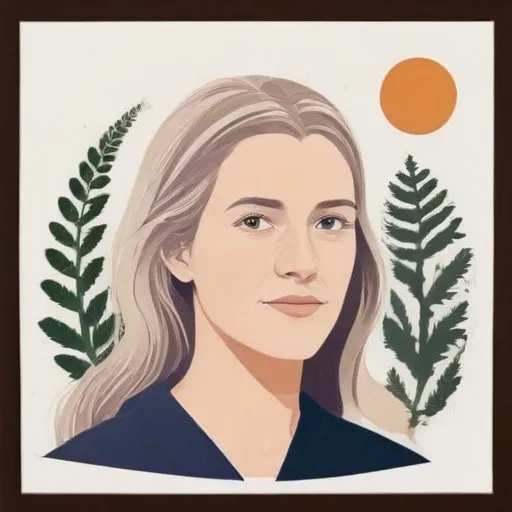
A 16th-century trailblazer in astronomy and horticulture, credited with assisting her uncle Tycho Brahe in his astronomical observations and creating a renowned botanical garden.
Sophia Brahe, a Danish noblewoman born in 1559, is renowned for her groundbreaking contributions to astronomy, chemistry, medicine, and horticulture, working alongside her brother Tycho Brahe, a prominent astronomer. Her multifaceted talents and relentless pursuit of knowledge propelled her to become a trailblazer in multiple fields, challenging the societal norms of her time.
Born in Knudstrup Castle, Denmark, Sophia was the youngest of ten children to Otte Brahe, the King of Denmark's advisor, and Beate Bille Brahe, leader of the royal household for Queen Sophie. Her older brother Tycho Brahe, more than a decade her senior, would become her closest ally and partner in the pursuit of scientific knowledge.
Despite their noble upbringing, Sophia and Tycho were united in their desire to pursue a life of science and knowledge, rather than conforming to the traditional roles expected of them. This shared passion brought them close, and they worked together to make astronomical observations, laying the foundation for Sophia's future endeavors.
In 1579, Sophia married Otto Thott, a man 13 years her senior, with whom she had a son, Tage Thott, born in 1580. Following Otto's death in 1588, Sophia took charge of his estate, Eriksholm (now Trolleholm Castle), overseeing its management and ensuring its profitability until her son came of age.
During this period, Sophia's interests in chemistry, medicine, and horticulture flourished. She became an accomplished horticulturalist, creating exceptional gardens in Eriksholm that showcased her innovative approach to botanical science.
Sophia's fascination with chemistry and medicine led her to study the works of Paracelsus, a renowned alchemist and physician. She explored the concept of using small doses of poison as medicine, a revolutionary idea at the time. By applying her knowledge, Sophia treated the local poor, providing them with medical assistance and earning their gratitude.
Though women were barred from receiving college degrees, Sophia's dedication to medicine did not waver. She continued to study and practice, albeit unofficially, using her skills to make a positive impact on her community.
Sophia Brahe's remarkable achievements in science, horticulture, and medicine have left an indelible mark on history. Her courage to challenge societal norms, her passion for knowledge, and her contributions to various fields have inspired generations of women to pursue careers in science, technology, engineering, and mathematics (STEM).
As a testament to her legacy, Sophia Brahe stands as a shining example of determination, intellect, and innovation, breaking barriers and paving the way for future generations of women in science.
Born in 1546
A 16th-century astronomer who made precise measurements of the stars and planets, laying the foundation for modern astronomy. His data helped Kepler discover planetary orbits.
Born in 1571
A 17th-century trailblazer who discovered the three laws of planetary motion, revolutionizing our understanding of the solar system. He's also credited with being a pioneer in the field of astrology.
Born in 1564
Pioneering astronomer, physicist, and mathematician who played a major role in the Scientific Revolution, making key discoveries that challenged Aristotelian views and laid the foundation for modern science.
Born in 1473
A Renaissance-era mathematician and astronomer who proposed the heliocentric model, where the Sun is at the center of our solar system, revolutionizing our understanding of the universe.
Born in 1514
A pioneering figure in the study of human anatomy, known for performing detailed dissections and creating accurate drawings of the body's inner workings, revolutionizing medical understanding.
Born in 1578
Discovered the circulatory system and described how blood flows through the body, revolutionizing understanding of human physiology.
Born in 1561
A 16th-17th century Renaissance figure who pioneered the scientific method and empiricism, and served as a prominent government official.
Born in 1596
Developed influential philosophical and mathematical concepts, including the famous phrase "I think, therefore I am," and laid the foundation for modern Western philosophy.
