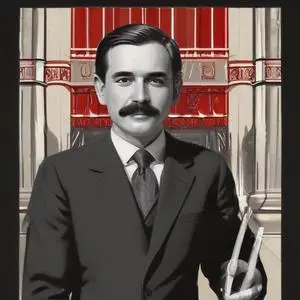
Stanford White: The Visionary Architect of the American Renaissance
Defining the Gilded Age
Stanford White was the preeminent architect of the Gilded Age, renowned for designing opulent houses for the wealthy, as well as iconic civic, institutional, and religious buildings that epitomized the grandeur of the era. As a partner in the esteemed architectural firm McKim, Mead & White, White's work embodied the American Renaissance, a cultural and artistic movement that sought to revive classical European styles.
Early Life and Training
Born on November 9, 1853, in New York City, White was the son of Richard Grant White, a Shakespearean scholar, and Alexina Black Mease. Growing up in a family steeped in art and culture, White was exposed to the works of John LaFarge,
Louis Comfort Tiffany, and
Frederick Law Olmsted, which would later influence his architectural style.
- At 18, White began his apprenticeship under Henry Hobson Richardson, a prominent architect known for his Richardsonian Romanesque style.
- He worked with Richardson for six years, learning the intricacies of architecture and developing his own unique approach.
Design Principles and Philosophy
White's architectural philosophy was rooted in the principles of beauty, harmony, and balance. He believed that buildings should be designed to inspire and uplift, rather than simply serve a functional purpose.
His designs often featured:
- Classical elements, such as columns, arches, and domes
- Ornate details, like intricate carvings and decorative moldings
- A emphasis on natural light and ventilation
Career Highlights and Major Works
White's portfolio boasts an impressive array of iconic buildings, including:
- The Washington Square Arch, a temporary structure that became so popular it was replaced with a permanent version
- The Players Club, a private social club founded by Edwin Booth
- The New York Herald Building, a prominent newspaper office
- Vanderbilt House, a grand mansion built for Cornelius Vanderbilt II
Personal Milestones and Key Life Events
White's personal life was marked by both triumph and tragedy.
- In 1884, he married Bessie Springs Smith, with whom he had one son, Lawrence
- He was known for his charismatic personality and was a prominent figure in New York society
- In 1906, White was murdered by Harry Kendall Thaw, a wealthy and mentally unstable heir, during a musical performance at Madison Square Garden
The Trial of the Century
The trial of Harry Kendall Thaw, accused of murdering Stanford White, was dubbed the "Trial of the Century" due to its sensational nature and the involvement of high-society figures.
The trial was marked by:
- Accusations of drugging and rape against White, involving Thaw's wife, Evelyn Nesbit
- A sex scandal that rocked the nation, with Thaw ultimately being found not guilty by reason of insanity
Legacy and Impact
Stanford White's legacy extends far beyond his architectural masterpieces. He played a significant role in shaping the aesthetic of the Gilded Age, and his work continues to inspire architects and designers today.
His influence can be seen in:
- The development of the Beaux-Arts style, which dominated American architecture in the early 20th century
- The preservation of historic buildings and landmarks, which White championed throughout his career
Stanford White's tragic death may have cut his life short, but his architectural legacy continues to endure, a testament to his boundless creativity and vision.
FAQ
What was Stanford Whites role in American architecture?
Stanford White was a prominent American architect who played a significant role in shaping the countrys architectural style. He was a partner in the firm McKim, Mead & White and designed many iconic buildings, including the Washington Square Arch and the Boston Public Library.
What were Stanford Whites influences on American architecture?
Stanford Whites influences on American architecture were vast, and he is credited with popularizing the Beaux-Arts style and introducing European classical elements to American design.
What were Stanford Whites most famous works?
Stanford Whites most famous works include the Washington Square Arch, the Boston Public Library, and the Newport Casino.
What was Stanford Whites legacy in architecture?
Stanford Whites legacy in architecture is as a pioneer of American design and a champion of the Beaux-Arts style. His work continues to influence architects and designers today.
What were the circumstances of Stanford Whites death?
Stanford White was murdered in 1906 by Harry K. Thaw, the husband of Evelyn Nesbit, with whom White had had an affair. The scandal surrounding his death shocked the country and marked the end of an era in American architecture.