


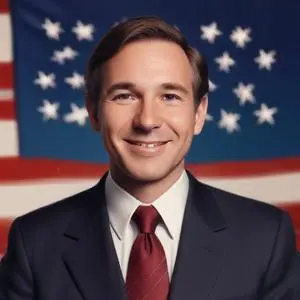
Renowned historian and author of bestselling books on World War II and American history, including biographies of Dwight D. Eisenhower and Richard Nixon. His writing style made history accessible to a broad audience.
Stephen E. Ambrose, a celebrated historian, academic, and author, is renowned for his captivating biographies of U.S. Presidents Dwight D. Eisenhower and Richard Nixon. His works of American popular history have captivated readers and scholars alike, earning him a reputation as one of the most prolific and engaging historians of his time.
Ambrose's fascination with history began early, inspired by his father's service in the U.S. Navy during World War II. Born on January 10, 1936, in Lovington, Illinois, Ambrose grew up in Whitewater, Wisconsin, where he developed a passion for storytelling and history. He attended the University of Wisconsin-Madison, where he earned a B.A. in history in 1957, and later received his master's degree from Louisiana State University in 1958 and his Ph.D. from the University of Wisconsin-Madison in 1963.
Ambrose's academic career spanned over three decades, during which he taught at several institutions, including the University of New Orleans, where he was appointed the Boyd Professor of History in 1989. He wrote over 30 books, many of which became bestsellers, including his acclaimed biographies of Eisenhower and Nixon. Ambrose's writing style, marked by vivid storytelling and meticulous research, made history accessible to a broad audience.
Ambrose's contributions to historical scholarship were recognized with numerous awards, including the National Medal of Arts, the Presidential Medal of Freedom, and the Jefferson Lecture in the Humanities.
Ambrose believed that history should be accessible to everyone, not just academics. He advocated for the importance of understanding America's past to inform its future. Through his writing, Ambrose aimed to inspire a sense of national pride and responsibility, emphasizing the significance of individual actions in shaping the course of history.
Stephen E. Ambrose's legacy extends far beyond his written works. He inspired a generation of historians, writers, and enthusiasts to explore America's rich history. His commitment to storytelling and scholarship continues to captivate readers, ensuring that the stories of America's past will continue to resonate with future generations.
Ambrose's life's work serves as a testament to the power of history to shape our understanding of ourselves and our place in the world. As he once said, "The past is a source of knowledge, and the future is a source of hope. Love of the past implies faith in the future."
Born in 1890
Led the Allied forces to victory in World War II and later served as President, maintaining peace and prosperity during the Cold War era. He's known for his strategic leadership and diplomatic skills.
Born in 1885
A renowned military leader who played a crucial role in World War II, particularly in the Allied victory in Europe, known for his bold tactics and unapologetic style.
Born in 1893
Led the US Army in World War II and became the last five-star general, playing a crucial role in shaping post-war American military strategy. He's also known for his humble and unassuming leadership style.
Born in 1880
A highly decorated military leader and statesman who played a crucial role in shaping post-WWII foreign policy and was awarded the Nobel Peace Prize for his efforts. He's most known for authoring the Marshall Plan, a massive economic aid program that helped rebuild war-torn Europe.
Born in 1882
Led the United States through the Great Depression and World War II, implementing a series of reforms known as the New Deal and helping to establish the country as a global superpower.
Born in 1884
The 33rd President of the United States, a strong leader who made tough decisions, including dropping atomic bombs on Japan and establishing the Marshall Plan to rebuild Europe after WWII.
Born in 1913
The 37th President of the United States, a polarizing figure who led the country through significant domestic and foreign policy changes, infamous for his involvement in the Watergate scandal.
Born in 1917
The 35th President of the United States was a charismatic leader who navigated the country through the Cuban Missile Crisis and advocated for civil rights, leaving a lasting legacy in American politics.
