


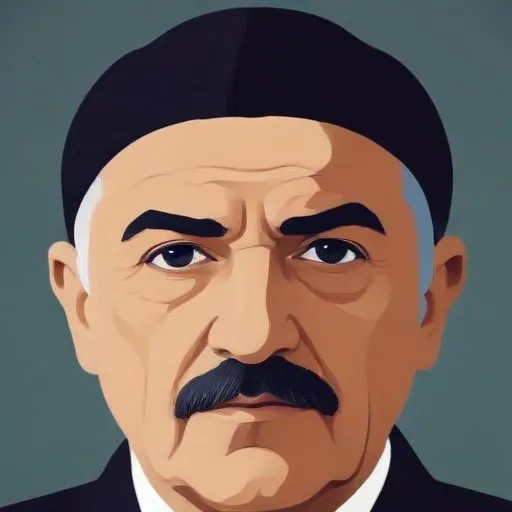
Greek general and politician who served as Deputy Prime Minister of Greece, known for his role in the 1967 military coup and subsequent regime.
Stylianos Pattakos, a Greek military officer, is infamously known for being one of the key principals of the Greek military junta that overthrew the government of Panagiotis Kanellopoulos in a coup d'état on April 21, 1967. This drastic move marked the beginning of a seven-year authoritarian regime that would shape the course of Greek history.
Born on November 8, 1912, in the picturesque village of Agia Paraskevi in Rethymno Prefecture, Crete, Pattakos came from a humble farming family. He pursued his passion for the military by enrolling in the Hellenic Military Academy, where he honed his skills and eventually rose through the ranks.
In the early hours of April 21, 1967, Pattakos, along with Georgios Papadopoulos and Nikolaos Makarezos, orchestrated a bloodless coup that ousted the government of Panagiotis Kanellopoulos. The junta, citing political anomaly as the reason for their action, swiftly arrested leading politicians and journalists, among them Konstantinos Mitsotakis, Andreas Papandreou, Georgios Rallis, and Manolis Glezos.
As the Minister of the Interior, Pattakos wielded significant power, using it to strip Greek actress and political activist Melina Mercouri of her Greek citizenship and confiscate her property. Mercouri's defiant response, "I was born Greek. I will die Greek. Mr. Pattakos was born a fascist. He will die a fascist," remains a testament to the resistance against the junta's oppressive regime.
In 1973, Brigadier General Dimitrios Ioannides overthrew Papadopoulos, marking the beginning of the end of the seven-year junta. The following year, the newly restored democratic government of Constantine Karamanlis put the junta officials on trial, charging them with high treason and insurrection.
Pattakos spent the remainder of his life in relative seclusion, passing away on October 8, 2016, at the age of 103.
Stylianos Pattakos's legacy remains shrouded in controversy, with many regarding him as a symbol of authoritarianism and oppression. His role in the junta has been widely criticized, and his actions during that period continue to be a topic of debate among historians and scholars.
Born in 1919
A Greek military officer who led a coup in 1967 and ruled Greece as a dictator until 1974, known for his authoritarian regime and human rights abuses.
Born in 1923
A Greek general who orchestrated a 1967 military coup, leading to a seven-year authoritarian regime in Greece. He's infamous for his brutal suppression of dissent and human rights abuses.
87 Years Old
A Greek poet and politician who fought against the military dictatorship in Greece, known for his bravery and sacrifice, including a famous attempt to assassinate the dictator.
Born in 1919
Greek economist and politician who served as Prime Minister of Greece, known for his socialist policies and efforts to reduce Greece's reliance on foreign capital. He also played a key role in Greece's accession to the European Union.
Born in 1907
A Greek lawyer and politician who served as President of Greece, known for leading the country's transition from military dictatorship to democracy. He's credited with modernizing Greece and joining the European Union.
Born in 1902
A Greek philosopher and politician who served as the 138th Prime Minister of Greece, known for his brief but significant term during a tumultuous period in Greek history. He played a key role in shaping the country's post-war politics.
Born in 1918
Greek lawyer and politician who served as the 178th Prime Minister of Greece, known for his efforts to modernize and liberalize the Greek economy. He played a key role in Greece's accession to the European Union.
