


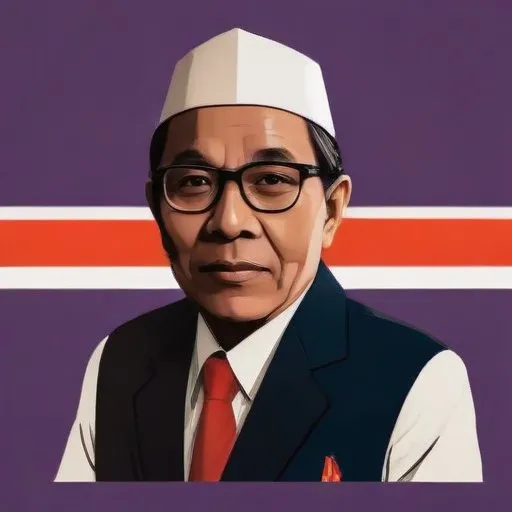
The 5th Vice President of Indonesia, serving from 1988 to 1993, known for his role in shaping the country's politics and economy during a period of significant transformation.
Sudharmono, affectionately known as Pak Dar, was the fifth Vice President of Indonesia, serving under the New Order regime of President Suharto from 1988 to 1993. As a seasoned politician and army officer, Sudharmono played a pivotal role in shaping the country's political landscape during a tumultuous period in Indonesian history.
Born on March 12, 1927, in Gresik, East Java, Sudharmono's early life was marked by a strong sense of patriotism and dedication to his country. He dropped out of middle school in 1945 to join the army during the Indonesian National Revolution, eventually becoming the Commander of the Ronggolawe Division.
After the Dutch retreated from Indonesia in 1949, Sudharmono completed his secondary education before joining the Military Law Academy in Jakarta, which he completed in 1956. He went on to serve as an Army Attorney in Medan, North Sumatra, from 1957 to 1961, and later participated in the Indonesia-Malaysia confrontation and the Supreme Operations Command KOTI.
Following the Fall of Sukarno after the 30 September Movement, Sudharmono's career took a significant turn when he was named Cabinet Secretary and Chairman of the Economic Stability Council by Suharto. This marked the beginning of his close association with the President, which would last for over two decades.
In 1970, Sudharmono was appointed State Secretary, a position that allowed him to work closely with Suharto in the day-to-day running of the government. His leadership skills and strategic thinking earned him the respect and trust of the President, paving the way for his eventual rise to the position of Vice President.
In 1988, Sudharmono was elected as Vice President to accompany Suharto during the General Assembly of the People's Consultative Assembly (MPR). As Vice President, he was instrumental in implementing various policies and programs aimed at stabilizing the economy and maintaining social order.
Sudharmono's tenure as Vice President was marked by significant achievements, including the introduction of economic reforms, infrastructure development, and social welfare programs. His leadership played a crucial role in maintaining stability and continuity during a period of great change and uncertainty in Indonesia.
Sudharmono's approach to governance was shaped by his strong belief in the importance of stability and continuity. He was a firm advocate of the New Order regime's ideology, which emphasized the need for a strong, centralized government to maintain national unity and stability.
In his public speeches and statements, Sudharmono frequently emphasized the importance of national unity, social harmony, and economic development. He believed that these elements were essential for Indonesia's progress and prosperity, and worked tirelessly to promote them throughout his career.
Sudharmono's legacy as a politician, army officer, and Vice President of Indonesia continues to be felt to this day. His commitment to national unity, social harmony, and economic development helped shape the country's trajectory during a critical period in its history.
As a testament to his enduring influence, Sudharmono's name remains synonymous with the New Order regime, and his contributions to Indonesia's development are still widely recognized and respected. His life serves as a powerful reminder of the importance of leadership, dedication, and service to one's country.
Born in 1921
The authoritarian leader who ruled Indonesia for three decades, known for his iron-fisted governance and economic development, but also accused of human rights abuses and corruption.
79 Years Old
First female President of Indonesia, leading the country from 2001 to 2004 and playing a key role in its transition to democracy. She's a symbol of female empowerment in a predominantly Muslim country.
86 Years Old
A journalist and politician who served as the 4th President of Indonesia, known for promoting democracy and interfaith dialogue in a country with the world's largest Muslim population. He was a key figure in Indonesia's transition to democracy after decades of authoritarian rule.
77 Years Old
The first democratically elected President of Indonesia, serving from 2004 to 2014, known for maintaining stability and promoting economic growth during his tenure. He also played a key role in combating terrorism and separatist movements.
65 Years Old
The first Indonesian president from a lower-middle-class background, known for his efforts to boost economic growth and infrastructure development, while also promoting tolerance and pluralism.
79 Years Old
A former Indonesian military commander who played a key role in the country's transition to democracy and later served as a cabinet minister, known for his efforts to reform the military and promote human rights.
