


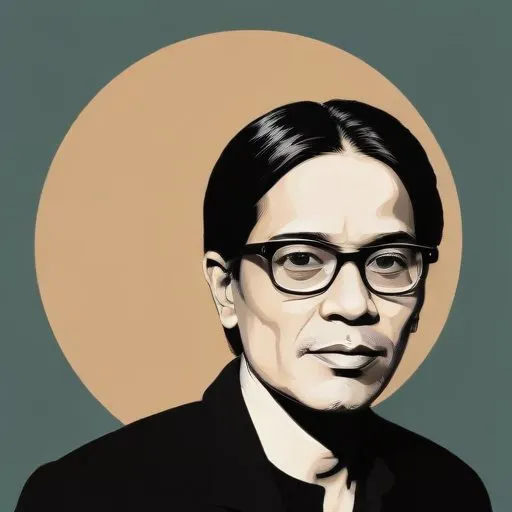
A renowned Bengali writer, humorist, and playwright, celebrated for his whimsical and nonsensical creations, blending fantasy and satire to entertain and critique society.
Sukumar Ray, the celebrated Bengali writer and poet, is revered for his enchanting works that have captivated the hearts of children and adults alike. Best known for his whimsical tales and poems that transport readers to a world of fantasy and imagination, Ray's literary creations continue to inspire and delight.
Ray was born into a family of creative minds on October 30, 1887, in Calcutta (now Kolkata), India. His father, Upendrakishore Ray Chowdhury, was a renowned writer, painter, violin player, and composer, while his mother, Bidhumukhi Devi, was the daughter of the reformer Dwarkanath Ganguly. This rich cultural heritage instilled in Ray a deep love for literature and the arts.
Growing up in an era of cultural and intellectual fervor, Ray was fortunate to befriend some of the most prominent figures of the Bengal Renaissance. His close relationships with Jagdish Chandra Bose, Acharya Prafulla Chandra Ray, and Rabindranath Tagore greatly influenced his thoughts and writings. Tagore, in particular, left an indelible mark on Ray's literary style, encouraging him to explore the world of fantasy and imagination.
Ray's most notable contributions to Bengali literature are his works for children. His poems and stories, characterized by their simplicity, wit, and humor, have become an integral part of Bengali children's literature. His magnum opus, Abol Tabol, a collection of nonsense verses, is still widely read and cherished today. Ray's works not only entertained but also educated children, instilling in them a sense of curiosity and wonder.
Sukumar Ray's impact on Bengali literature is immeasurable. He not only enriched the canon of children's literature but also inspired generations of writers and poets. His son, Satyajit Ray, went on to become a celebrated filmmaker, and his works continue to influence Indian cinema. Ray's legacy extends beyond the realm of literature, inspiring a new wave of creative minds to explore the world of imagination and fantasy.
Sukumar Ray's remarkable life and works continue to captivate audiences, inspiring new generations to explore the world of imagination and creativity. His legacy, a testament to the power of literature and art, remains an integral part of Bengali cultural heritage.
"The world is full of wonders, and the greatest wonder of all is the human mind."
Though Sukumar Ray passed away on September 10, 1923, his works continue to inspire and delight, leaving behind a rich cultural legacy that will be cherished for generations to come.
Born in 1861
A Bengali polymath who wrote extensively on love, nature, and humanity, creating a unique blend of Indian and Western literary styles, and was the first non-European to win the Nobel Prize in Literature.
Born in 1921
Acclaimed filmmaker behind iconic Indian movies that beautifully blend social commentary with poignant storytelling, earning numerous international accolades. 82
Born in 1908
A renowned Bengali writer, poet, and playwright, celebrated for his contributions to Indian literature, particularly in the genre of magic realism. His works often explored the human condition, blending fantasy and reality.
Born in 1899
A Bengali poet and writer who explored themes of love, nature, and the human condition through his unique and innovative style, leaving a lasting impact on Bengali literature.
Born in 1876
A renowned Bengali novelist celebrated for his poignant and thought-provoking works that explored the complexities of Indian society, particularly the lives of women and the rural poor.
Born in 1838
A pioneering Bengali writer and poet who played a significant role in shaping Indian literature, known for his iconic novel "Anandamath" that inspired India's freedom movement.
Born in 1876
A renowned Bengali novelist celebrated for his poignant and thought-provoking works that explored the complexities of Indian society, particularly the lives of women and the rural poor.
