


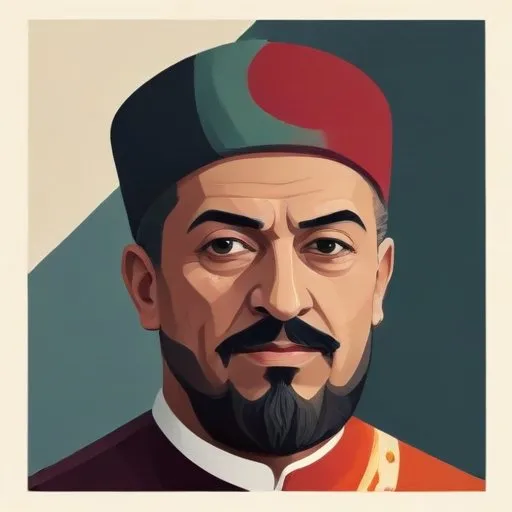
Ottoman prince and statesman who vied for the throne, known for his diplomatic efforts to form alliances with European powers against his brother, Sultan Bayezid II.
Sultan Cem, the youngest son of Mehmed II, is renowned for his valiant yet ultimately unsuccessful quest for the Ottoman throne, a saga of political maneuvering, familial rivalries, and international intrigue that captivated the Renaissance world.
Cem's life was a tumultuous dance of alliances and betrayals, marked by his determination to supplant his brother, Bayezid II, as the Sultan of the Ottoman Empire. His audacious campaigns and Machiavellian tactics earned him notoriety, as well as the admiration of European powers who saw him as a potential pawn in their own geopolitical games.
Born in 1459, Cem was the third son of Mehmed II, the Conqueror, and his wife, Gülbahar Hatun. As a young prince, he was educated in the arts of war and statecraft, and his father's military campaigns instilled in him a sense of destiny and ambition.
Following Mehmed II's death in 1481, Cem's brother, Bayezid II, ascended to the throne, marginalizing Cem and his supporters. This sparked a fraternal rivalry that would propel Cem's life of intrigue and rebellion.
Cem's early attempts to usurp the throne were thwarted, and he fled to Egypt, seeking the protection of the Mamluk Sultan, Qaitbay. This strategic alliance allowed Cem to regroup and plan his next move, as he navigated the complex web of Ottoman politics and European rivalries.
His subsequent forays into Anatolia and the Mediterranean were backed by various European powers, including the Knights Hospitaller, the Pope, and the French monarchy. These alliances, however, proved fleeting and often treacherous, as Cem's fortunes waxed and waned amidst the treacherous landscape of Renaissance geopolitics.
Cem's turbulent life was marked by both military triumphs and crushing defeats. His final campaign, which ended in 1495, saw him defeated by his brother's forces in Anatolia. He was eventually captured and imprisoned in the Castle of Bourganeuf in France, where he died in 1495, allegedly poisoned by an unknown assassin.
Despite his ultimate failure to secure the throne, Sultan Cem's legacy as a master strategist and diplomat has endured. His life serves as a testament to the complexities of Ottoman politics and the intrigue that often accompanied the pursuit of power in the Renaissance world.
"I am the son of the Sultan, and I will not be ignored." - Sultan Cem, in a letter to his brother, Bayezid II
Sultan Cem's life played out against the backdrop of Ottoman expansion, European rivalries, and the dawn of the Renaissance. His story is intertwined with the machinations of European powers, the rise of the Habsburgs, and the Ottoman Empire's own struggles for dominance.
Today, Cem's legacy is remembered as a cautionary tale of ambition and the cutthroat nature of Renaissance politics. His life serves as a reminder of the intricate web of alliances, rivalries, and betrayals that shaped the destiny of empires and nations.
Born in 1642
The Ottoman sultan who ruled from 1648 to 1687, known for his military campaigns that expanded the empire's borders, including the conquest of Crete and parts of Poland. He was also known for his cultural and architectural achievements, including the construction of several mosques and palaces.
Born in 1566
The Ottoman Empire's 13th Sultan, who ruled from 1595 to 1603, is known for his military campaigns in Europe and the Middle East, and for executing many of his brothers and half-brothers to secure his throne.
Born in 1546
The Ottoman Empire's 12th ruler, known for his lavish spending, cultural achievements, and military conquests that expanded the empire's borders, including the capture of Cyprus and parts of Eastern Europe.
Born in 1761
Reformed the Ottoman Empire's military and administration, introducing Western-style reforms to modernize the state. Known for his efforts to centralize power and reduce corruption.
Born in 1494
Ruling the Ottoman Empire at its peak, he expanded its borders, conquered Belgrade, and laid siege to Vienna, earning a reputation as a brilliant military strategist and statesman. He also codified laws and reformed the empire's administration.
Born in 1447
The Ottoman Empire's eighth ruler, known for his military campaigns, administrative reforms, and cultural patronage, which led to a golden age of Ottoman architecture and art. He also oversaw the expulsion of Jews from Spain, offering them refuge in the Ottoman Empire.
Born in 1664
Ottoman Empire's 22nd ruler, known for his military campaigns in Europe, particularly the Great Turkish War, and his eventual defeat at the Battle of Zenta.
Born in 1699
The Ottoman Empire's 25th Sultan, ruling from 1754 to 1757, known for his brief and uneventful reign, marked by a lack of significant reforms or military campaigns.
