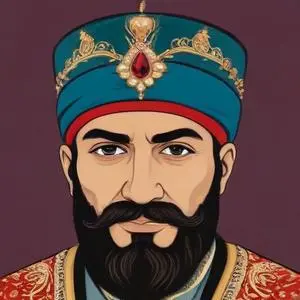
Mehmed III: The Sultan of Controversy and Conquest
A Legacy of Fratricide and Military Triumphs
Mehmed III, the Sultan of the Ottoman Empire from 1595 to 1603, is notoriously known for ordering the execution of his nineteen brothers upon ascending to the throne. This gruesome act of fratricide, although not unprecedented in Ottoman history, cemented Mehmed's reputation as a ruthless and powerful leader. In contrast, he is also celebrated for his military prowess, leading the Ottoman army to victory in the Long Turkish War and the decisive Battle of Keresztes.
Early Life and Royal Upbringing
Born on May 26, 1566, at the Manisa Palace, Mehmed was the son of
Murad III and Safiye Sultan, an Albanian from the Dukagjin Highlands. His great-grandfather,
Suleiman the Magnificent, died the same year Mehmed was born, and his grandfather, Selim II, became the new Sultan. Mehmed spent his childhood in Manisa with his parents and his teacher, Ibrahim Efendi, where he received a traditional Ottoman education.
Reign and Controversies
Mehmed's reign was marked by controversy and power struggles. Upon ascending to the throne, he ordered the execution of his brothers, deeming them a threat to his rule. This brutal act was only the beginning of a series of conflicts that would define his reign. His mother, Safiye Sultan, wielded significant power as the valide sultan, often making decisions on behalf of her son. This led to a power struggle in Constantinople, where Mehmed's inactivity and reliance on his mother's counsel created tensions among the ruling elite.
Military Campaigns and Diplomacy
Despite his tumultuous reign, Mehmed III achieved significant military successes. He led the Ottoman army to victory in the Long Turkish War, which included the Battle of Keresztes, a decisive Ottoman triumph. However, the war was not without its setbacks, including losses in Gyor and Nikopol. Mehmed also successfully quelled the Jelali rebellions, a series of uprisings that threatened Ottoman stability. In addition to his military prowess, Mehmed attempted to strengthen commercial relations with England, communicating with the court of Elizabeth I in the hopes of forming an alliance against the Spanish.
Personal Milestones and Legacy
Mehmed's personal life was marked by significant milestones. His circumcision ceremony took place on May 29, 1582, when he was 16 years old. His reign was also marked by significant architectural projects, including the construction of several mosques and the renovation of the Topkapi Palace. Mehmed's legacy is complex, characterized by both brutality and military brilliance. His reign, although marked by controversy, solidified the Ottoman Empire's position as a dominant world power.
Historical Context and Comparative Analysis
Mehmed III's reign must be considered within the context of the Ottoman Empire's expansion and consolidation of power. His military campaigns and diplomatic efforts were integral to the empire's growth and stability. In comparison to his contemporaries, Mehmed's reign was marked by a unique blend of brutality and military prowess, setting him apart from other Ottoman sultans. His legacy continues to fascinate historians and scholars, offering a glimpse into the complexities of the Ottoman Empire's Golden Age.
Trivia and Fun Facts
- Mehmed III's mother, Safiye Sultan, was an Albanian from the Dukagjin Highlands.
- He was circumcised at the age of 16, a significant milestone in Ottoman culture.
- Mehmed III communicated with the court of Elizabeth I, hoping to form an alliance against the Spanish.
A Lasting Impact on the Ottoman Empire
Mehmed III's reign, although tumultuous, left an indelible mark on the Ottoman Empire. His military campaigns and diplomatic efforts solidified the empire's position as a dominant world power. His legacy, complex and multifaceted, continues to intrigue historians and scholars, offering a glimpse into the intricacies of the Ottoman Empire's Golden Age.
FAQ
Who was Mehmed III, Ottoman Sultan?
Mehmed III was the Sultan of the Ottoman Empire from 1595 to 1603, during a period of significant expansion and conflict.
What were Mehmed IIIs military campaigns?
Mehmed III led successful military campaigns against the Habsburgs, including the capture of Eger in 1596, and against the Safavid Empire, including the capture of Tabriz in 1603.
How did Mehmed III consolidate power in the Ottoman Empire?
Mehmed III consolidated power by eliminating potential rivals, including his brothers and other high-ranking officials, and by centralizing authority in the imperial administration.
What was Mehmed IIIs relationship with European powers?
Mehmed III maintained complex and often conflicting relationships with European powers, including the Habsburgs, the Safavid Empire, and the Republic of Venice.
How is Mehmed III remembered in Ottoman history?
Mehmed III is remembered as a skilled military leader who expanded the Ottoman Empire and consolidated power, but also as a ruthless and autocratic ruler who eliminated potential rivals and opponents.