


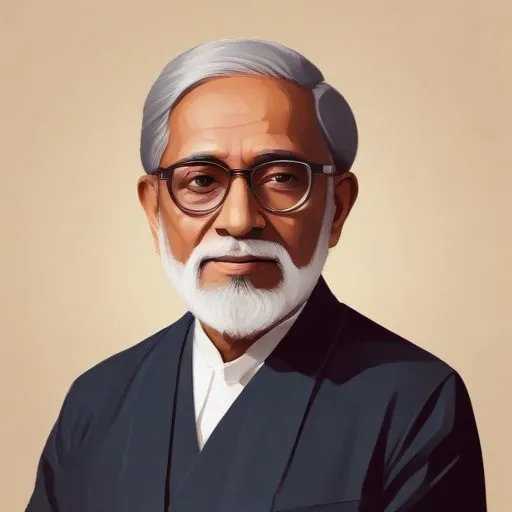
An Indian intellectual and statesman who played a key role in India's independence movement and was one of the founders of the Indian National Congress, advocating for Indian self-rule and rights. He was a pioneer in Indian politics, education, and journalism.
Surendranath Banerjee, fondly referred to as the Rashtraguru or "Teacher of the Nation," was a pioneering Indian nationalist leader who played a pivotal role in bridging the gap between Hindus and Muslims during the British Raj. He founded the Indian National Association, an organization that sought to unite the two communities for a common cause – the fight for Indian independence.
Born on November 10, 1848, in Calcutta, Bengal, Surendranath Banerjee hailed from a Rarhi Kulin Brahmin family. His father, Durga Charan Banerjee, a doctor, instilled in him liberal and progressive values that would shape his future endeavors. After graduating from the University of Calcutta, Banerjee traveled to England in 1868 to compete in the Indian Civil Service examinations, where he was influenced by Western ideas and philosophies.
Despite initial setbacks, including being barred from the Indian Civil Service due to an age discrepancy, Banerjee persevered and cleared the exam again in 1871. He returned to India and began his career as an assistant magistrate in Sylhet. However, his true calling lay in politics, and he soon became a prominent figure in the Indian nationalist movement.
In 1876, Banerjee founded the Indian National Association, an organization dedicated to promoting Indian self-rule and unity among Hindus and Muslims. This pioneering effort laid the groundwork for the Indian National Congress, which Banerjee co-founded in 1885. However, he later broke away from the Congress due to differences over the Montagu-Chelmsford Reforms, eventually founding the Indian National Liberation Federation in 1919.
Banerjee's liberal and progressive ideology was deeply rooted in his belief in the power of education and unity. He advocated for a gradual, constitutional approach to achieving Indian independence, rather than relying on revolutionary methods. His commitment to social reform and women's empowerment earned him widespread respect and admiration.
Surendranath Banerjee's contributions to Indian nationalism are immeasurable. He played a vital role in shaping the country's struggle for independence and paving the way for future leaders. His emphasis on education, social reform, and unity continues to inspire generations of Indians. As the Rashtraguru, Banerjee remains an iconic figure in Indian history, a testament to the power of progressive ideals and determination.
Banerjee received several accolades during his lifetime, including the title of "Rashtraguru" conferred upon him by Rabindranath Tagore. His legacy continues to be celebrated through various memorials and institutions, including the Surendranath College in Calcutta.
Born in 1861
A Bengali polymath who wrote extensively on love, nature, and humanity, creating a unique blend of Indian and Western literary styles, and was the first non-European to win the Nobel Prize in Literature.
Born in 1897
Indian freedom fighter and politician who led the Indian National Army against British rule and was a key figure in the country's struggle for independence. He is also known for his mysterious disappearance in 1945.
Born in 1889
India's first Prime Minister, a key figure in the country's struggle for independence from British rule, and a champion of democracy and secularism. He played a crucial role in shaping modern India's government and economy.
Born in 1869
Indian freedom fighter, activist, and philosopher who led India to independence from British rule through non-violent civil disobedience, inspiring civil rights movements worldwide.
Born in 1917
The first female Prime Minister of India, serving from 1966 to 1977 and again from 1980 until her assassination in 1984, known for her strong leadership and economic reforms.
Born in 1884
India's first president, a key figure in the country's struggle for independence, who played a crucial role in shaping the nation's early years. He's revered for his leadership and commitment to democracy.
Born in 1879
A pioneering Indian poet and activist who used her lyrical voice to advocate for women's rights and Indian independence, leaving a lasting legacy in Indian literature and politics.
Born in 1858
Indian freedom fighter and social reformer who played a key role in the Indian independence movement and advocated for women's rights and education.
