


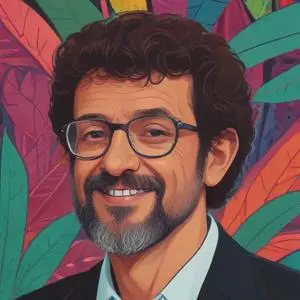
A counterculture icon who explored the boundaries of psychedelics, consciousness, and the human experience through writings and lectures. He's famous for his theories on the role of psychoactive substances in shaping human culture and evolution.
Terence McKenna, the renowned American ethnobotanist and mystic, is known for his groundbreaking work on the responsible use of naturally occurring psychedelic plants and his profound philosophical contributions to the fields of shamanism, metaphysics, and alchemy.
Born on November 16, 1946, in Paonia, Colorado, McKenna's fascination with the natural world began at a young age. His Irish ancestry and early interests in fossil hunting and psychology laid the foundation for his later exploration of the mystical and the unknown.
McKenna's charismatic personality, coupled with his vast knowledge of psychedelic plants and shamanic practices, earned him the moniker "the Timothy Leary of the 90s." He became the intellectual voice of the burgeoning rave culture, speaking and writing about a wide range of subjects, from environmentalism to the theoretical origins of human consciousness.
McKenna's most famous concept, Novelty Theory, posits that the universe is governed by a fractal pattern of increasing complexity, which he claimed to have discovered in the I Ching. This theory predicted the end of time and a transition of consciousness in the year 2012, sparking widespread interest in the Maya calendar and the 2012 phenomenon. While Novelty Theory is considered pseudoscience, its impact on popular culture cannot be overstated.
Terence McKenna's work has inspired a generation of thinkers, artists, and activists. His emphasis on the importance of responsible psychedelic use and environmental stewardship continues to resonate with contemporary audiences. While his ideas may be considered radical or unconventional by some, McKenna's influence on popular culture and the counterculture movement is undeniable.
Terence McKenna's untimely passing on April 3, 2000, did not silence his message. His ideas continue to inspire and provoke, inviting us to question the boundaries of human consciousness and our place within the cosmos.
94 Years Old
A countercultural icon who explored the realms of consciousness, paranoia, and conspiracy theories through his writings, blending psychology, philosophy, and humor. His works are a gateway to alternative perspectives and unconventional thinking.
Born in 1920
A pioneer in the counterculture movement, he advocated for the therapeutic use of psychedelic drugs and became a symbol of the 1960s rebellion. His ideas continue to influence modern thought on consciousness and personal freedom.
Born in 1926
A leading figure of the Beat Generation, known for his poetry that explores themes of nonconformity, free expression, and social justice. His iconic poem "Howl" is a classic of American literature.
Born in 1914
A pioneering figure of the Beat Generation, known for experimental and provocative works that blended fiction and reality, pushing boundaries of literature and art.
Born in 1922
Pioneering figure of the Beat Generation, known for spontaneous, confessional, and poetic writings that captured the essence of American counterculture in the 1950s and 60s.
89 Years Old
A pioneering journalist and author who blurred the lines between fiction and reality, creating a unique brand of Gonzo journalism that captivated readers with its unapologetic honesty and dark humor.
91 Years Old
Counterculture icon and author of psychedelic novels, most famously "One Flew Over the Cuckoo's Nest", which critiques societal norms and explores the human condition.
