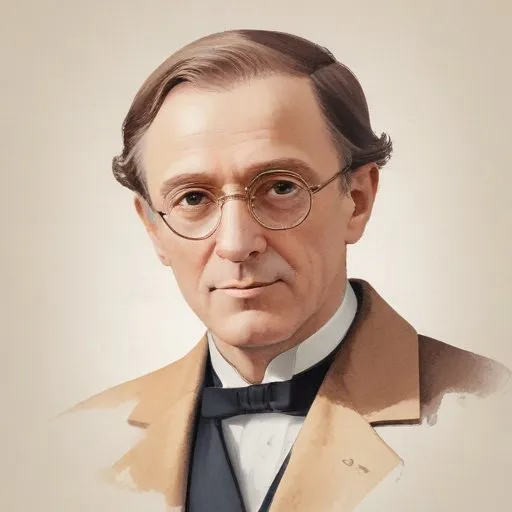
Theodore William Richards: The Pioneering Physical Chemist
A Legacy of Precision: Determining Atomic Weights
Theodore William Richards, an American physical chemist, made history by becoming the first American scientist to receive the Nobel Prize in Chemistry in 1914. His groundbreaking work earned him this prestigious award, as he precisely determined the atomic weights of a large number of chemical elements, revolutionizing the field of chemistry.
Early Life and Education
Born on January 31, 1868, in Germantown, Pennsylvania, Richards was raised in a family of artists. His father, William Trost Richards, was a landscape painter, and his mother, Anna Matlack Richards, was a poet. Despite the artistic influences, Richards' scientific curiosity was sparked at a young age. During a summer stay in Newport, Rhode Island, he met Professor Josiah Parsons Cooke of Harvard, who introduced him to the wonders of Saturn's rings through a small telescope. This encounter would later shape his career path.
Career Highlights and Academic Pursuits
Richards' academic journey began at Haverford College, Pennsylvania, where he earned a Bachelor of Science degree at the age of 16. He then pursued a Bachelor of Arts degree at Harvard University, graduating in 1886. Under the guidance of Professor Cooke, Richards delved into the determination of the atomic weight of oxygen relative to hydrogen for his doctoral dissertation. Following a year of postdoctoral work in Germany, studying under Victor Meyer at the University of Göttingen, Richards returned to Harvard as an assistant in chemistry. He climbed the academic ranks, becoming a full professor in 1901 and later, the chairman of the department of chemistry.
The Wolcott Gibbs Memorial Laboratory and Erving Professorship
In 1912, Richards was appointed Erving Professor of Chemistry and director of the new Wolcott Gibbs Memorial Laboratory at Harvard. This prestigious position allowed him to continue his research and mentor future generations of scientists.
Personal Life and Family
In 1896, Richards married Miriam Stuart Thayer, and the couple had one daughter, Grace Thayer, who later married
James Bryant Conant, a prominent chemist and educator.
Awards and Honors
In addition to the Nobel Prize in Chemistry, Richards received numerous awards and honors, including:
- Faraday Lectureship of the Royal Society (1911)
- Copley Medal of the Royal Society (1915)
- Willard Gibbs Award of the American Chemical Society (1916)
Legacy and Impact
Theodore William Richards' pioneering work on atomic weights has had a lasting impact on the field of chemistry. His precision and dedication to scientific inquiry have inspired generations of scientists, and his legacy continues to influence the development of modern chemistry.
Trivia and Fun Facts
- Richards was only 14 years old when he entered Haverford College.
- He was a member of the American Philosophical Society and served as its president from 1914 to 1917.
- Richards was an avid collector of rare books and manuscripts related to the history of science.
Theodore William Richards' remarkable journey, marked by academic excellence, groundbreaking research, and numerous accolades, solidifies his position as a leading figure in the history of chemistry.
FAQ
What was Theodore William Richards contribution to chemistry?
Theodore William Richards was an American chemist who made significant contributions to the field of chemistry, including the determination of atomic weights, which led to a greater understanding of the periodic table.
Why did Theodore William Richards win the Nobel Prize?
Theodore William Richards was awarded the Nobel Prize in Chemistry in 1914 for his accurate determination of the atomic weights of several elements, which was a major breakthrough in the field of chemistry at the time.
What were Theodore William Richards research interests?
Theodore William Richards research focused on atomic weights, electrochemistry, and thermodynamics. He was particularly interested in understanding the properties of elements and their relationships.
What was Theodore William Richards role in the development of modern chemistry?
Theodore William Richards played a crucial role in the development of modern chemistry by laying the foundation for the precise determination of atomic weights, which is essential for understanding the properties of elements and compounds.
How did Theodore William Richards work impact the scientific community?
Theodore William Richards work had a significant impact on the scientific community, as it led to a greater understanding of the periodic table and the properties of elements. His research also inspired further investigation into the field of chemistry, paving the way for future discoveries.