


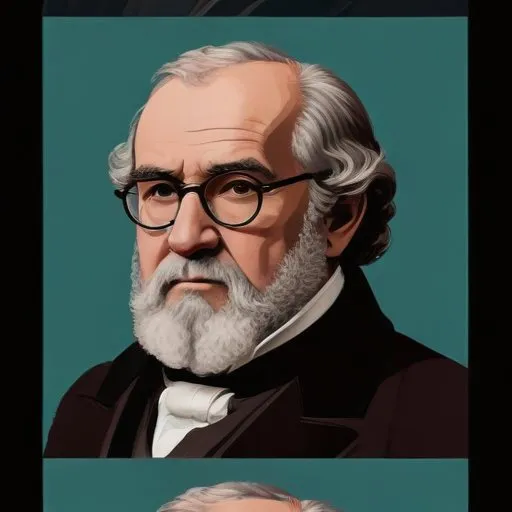
A journalist and author who wrote novels and travelogues, particularly known for his vivid descriptions of Italy and its people.
Thomas Adolphus Trollope was an English writer who left an indelible mark on the literary world with his impressive oeuvre of over 60 books, mostly revolving around his adopted home, Italy. As a prolific author of travel writing, history, and fiction, Trollope's works offer a captivating glimpse into the Italy of the 19th century, a period of great change and upheaval.
Born on April 29, 1810, in Bloomsbury, London, Trollope was the eldest son of Thomas Anthony and Frances Milton Trollope. His younger brother, Anthony Trollope, would later become a renowned novelist in his own right. After receiving his education at Harrow School and Winchester College, Trollope went on to matriculate at St Alban Hall, Oxford, in 1829, and graduated with a B.A. from Magdalen Hall, Oxford, in 1835.
Trollope's writing career was initially sparked during a trip to New York with his father. However, it was his mother's suggestion that he form a writing partnership with her that proved to be the turning point in his literary journey. This partnership led him to Italy, where he would spend most of his life, creating a renowned villa in Florence with his first wife, Theodosia, and later another center of British society in Rome with his second wife, the novelist Frances Eleanor Trollope.
Trollope's Italy-centric works, which spanned multiple genres, including travel writing, history, and fiction, offer a unique perspective on the country during a time of great transformation. His writing not only captured the essence of Italy but also contributed significantly to the country's literary landscape. Some of his notable works include:
Trollope's literary endeavors were rewarded when he was awarded the Order of Saints Maurice and Lazarus by Victor Emmanuel II of Italy. This prestigious honor was a testament to his contributions to Italian literature and culture.
Trollope married twice, first to Theodosia Garrow, with whom he had a daughter, Beatrice, and later to Frances Eleanor Trollope, a novelist in her own right. His homes in Florence and Rome became hubs for British intelligentsia and Italian nationalist figures, earning him a reputation as a gracious host and patron of the arts. Trollope's legacy as a chronicler of 19th-century Italy continues to captivate readers to this day, offering a fascinating glimpse into a bygone era.
Through his remarkable body of work, Thomas Adolphus Trollope has left an indelible mark on the literary world, cementing his place as one of the most prolific and engaging writers of his time.
Born in 1815
A prolific writer of novels, essays, and short stories, known for his insightful portrayals of Victorian society and politics. His works are still widely read and adapted today.
Born in 1812
A renowned author of timeless classics, crafting vivid stories that exposed social injustices and explored the human condition, leaving an indelible mark on literature.
Born in 1811
Satirical novelist and illustrator of Victorian society, known for his witty and insightful portrayals of the English upper class, particularly in his novel "Vanity Fair".
Born in 1803
A prolific writer of novels, plays, and poetry, known for coining the phrase "the pen is mightier than the sword" and influencing the detective fiction genre.
Born in 1819
A priest, historian, and author who wrote influential novels and historical works, including "The Water-Babies" and "Hypatia", which explored social and theological issues.
Born in 1795
A 19th-century historian, philosopher, and academic who wrote influential works on history, politics, and society, particularly "The French Revolution" and "On Heroes, Hero-Worship, and The Heroic in History".
Born in 1819
A prominent art critic and social reformer who championed the Pre-Raphaelite movement and advocated for social justice, leaving a lasting impact on art, architecture, and literature.
Born in 1810
A pioneering novelist of the Victorian era, known for her insightful portrayals of social class and women's lives in industrial England, particularly in her novel "North and South".
