


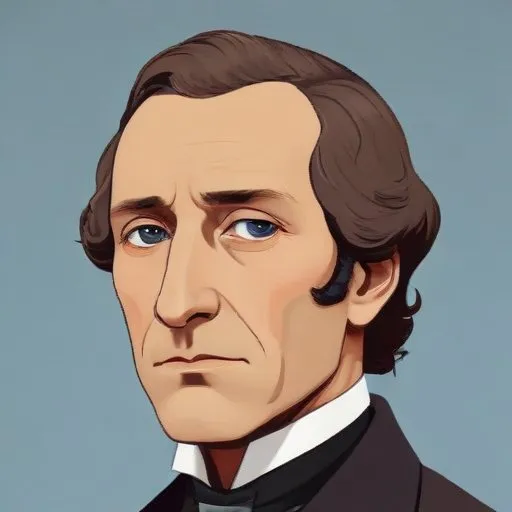
A prolific writer of novels, plays, and poetry, known for coining the phrase "the pen is mightier than the sword" and influencing the detective fiction genre.
Edward Bulwer-Lytton, a renowned English writer and politician, is best known for coining iconic phrases that have become an integral part of modern language, such as "the pursuit of the almighty dollar," "the pen is mightier than the sword," and "it was a dark and stormy night." His contributions to literature and politics have left an indelible mark on the world, earning him a lasting legacy.
Bulwer-Lytton was born on May 25, 1803, to General William Earle Bulwer and Elizabeth Barbara Lytton in Heydon Hall, Norfolk. After his father's death, his mother moved to London, where he was tutored by Wallington, who encouraged him to publish his early work, Ishmael and Other Poems, at the tender age of 15. He then attended Trinity College, Cambridge, where he met John Auldjo and won the Chancellor's Gold Medal for English verse in 1825.
Bulwer-Lytton's writing career spanned multiple genres, including poetry, novels, and plays. Some of his notable works include Eugene Aram, The Last of the Barons, and Rienzi, the Last of the Tribunes. His works were widely popular during his lifetime, and he was celebrated for his vivid descriptions and intricate plots.
Bulwer-Lytton's foray into politics began in 1831, when he was elected as a Whig member of Parliament. He later switched to the Conservative party in 1851 and served as Secretary of State for the Colonies from 1858 to 1859. During his tenure, he chose Richard Clement Moody as the founder of British Columbia. In 1862, he was offered the Crown of Greece, which he declined.
Bulwer-Lytton was a philhellene, deeply fascinated by ancient Greek culture and ideals. His works often reflected his philosophical views on politics, morality, and human nature. He believed in the power of literature to shape public opinion and influence social change.
Bulwer-Lytton's impact on modern society is undeniable. His phrases have become an integral part of popular culture, and his works continue to inspire writers and politicians alike. The Bulwer-Lytton Fiction Contest, held annually since 1982, seeks to find the worst possible opening sentence, a tongue-in-cheek tribute to his literary legacy.
Edward Bulwer-Lytton's contributions to literature, politics, and philosophy have left an indelible mark on the world. His works continue to be celebrated, and his legacy serves as a testament to the power of the written word to shape human thought and action.
Born in 1812
A renowned author of timeless classics, crafting vivid stories that exposed social injustices and explored the human condition, leaving an indelible mark on literature.
Born in 1804
A skilled politician who served as Prime Minister of the United Kingdom, known for his influential role in shaping the country's politics and economy during the 19th century.
Born in 1811
Satirical novelist and illustrator of Victorian society, known for his witty and insightful portrayals of the English upper class, particularly in his novel "Vanity Fair".
Born in 1812
A Victorian-era literary giant, renowned for crafting intricate, psychologically nuanced poetry and plays that probed the human condition, often exploring themes of love, death, and the nature of existence.
Born in 1806
A renowned poet and translator of the Victorian era, celebrated for her romantic and socially conscious works, particularly the iconic love poems "Sonnets from the Portuguese".
Born in 1809
Poet laureate of the United Kingdom during much of Queen Victoria's reign, famous for patriotic and romantic poems like "In Memoriam A.H.H." and "The Charge of the Light Brigade".
Born in 1820
Pioneering nurse and statistician who revolutionized healthcare by introducing sanitation practices and data-driven decision making, becoming the founder of modern nursing.
Born in 1791
Pioneering scientist who discovered electromagnetic induction, formulated the laws of electrolysis, and invented the first electrical generator, revolutionizing our understanding of electricity and its applications.
