


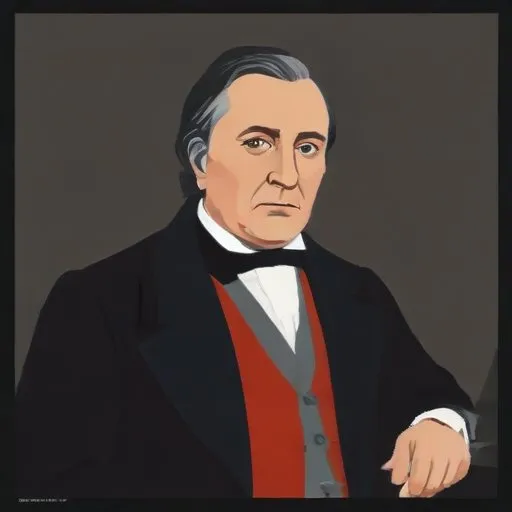
A renowned poet, historian, and politician who played a significant role in shaping British politics and literature in the 19th century, particularly through his writings on British history. He's also known for his influential essays and speeches that reflected his liberal and reformist views.
Thomas Babington Macaulay, a British historian, poet, and politician, is renowned for his seminal work, "The History of England", which cemented his reputation as a master storyteller and a champion of Western European culture. His monumental book is still celebrated for its lyrical prose, which brought the rich tapestry of British history to life.
Born on October 25, 1800, at Rothley Temple in Leicestershire, Macaulay was the son of Zachary Macaulay, a Scottish Highlander, and Selina Mills of Bristol. From a tender age, Macaulay demonstrated a prodigious intellect, often mesmerizing his family with his insatiable curiosity and love for learning.
Macaulay's education began at a private school in Hertfordshire, followed by Trinity College, Cambridge, where he excelled in various subjects, winning several prizes, including the prestigious Chancellor's Gold Medal in 1821. During his time at Cambridge, Macaulay developed a passion for poetry, publishing a notable essay on Milton in the Edinburgh Review in 1825.
Although Macaulay didn't study classical literature at Cambridge, he later devoured the works of ancient authors, including Virgil's Aeneid, which moved him to tears in 1851. He was a polyglot, teaching himself German, Dutch, and Spanish, and was fluent in French.
Macaulay's entry into politics began with his appointment as Secretary at War between 1839 and 1841, followed by his tenure as Paymaster General between 1846 and 1848. During this period, he continued to write, producing iconic works that would cement his reputation as a master historian and storyteller.
Published in five volumes between 1849 and 1861, "The History of England" is Macaulay's magnum opus, chronicling the Glorious Revolution of 1688 to the reign of Queen Anne in 1714. This sweeping narrative is celebrated for its vivid descriptions, incisive analysis, and lyrical prose, which has captivated readers for generations.
Macaulay's influence on British historiography is immeasurable, shaping the way historians approach their craft. His emphasis on the progress of Western European culture and its inevitable sociopolitical evolution has been widely debated and discussed. Today, Macaulay's work remains a testament to his boundless energy, intellect, and literary flair.
Through his writing, Macaulay has inspired countless historians, politicians, and writers, leaving an indelible mark on the British narrative. His legacy continues to inspire, educate, and enrich our understanding of the past, ensuring that his work will remain a vital part of our cultural heritage for generations to come.
In conclusion, Thomas Babington Macaulay's extraordinary life, marked by intellectual curiosity, literary genius, and public service, has left an enduring legacy that continues to captivate and inspire us today.
Born in 1819
The monarch who ruled the British Empire for 63 years, overseeing the Industrial Revolution and expanding the empire's reach, earning the nickname "the Grandmother of Europe".
Born in 1788
A British politician who served as Prime Minister and is credited with establishing the modern police force and repealing the Corn Laws, a major trade restriction. He's also known for his role in shaping the Conservative Party.
Born in 1812
A renowned author of timeless classics, crafting vivid stories that exposed social injustices and explored the human condition, leaving an indelible mark on literature.
Born in 1811
Satirical novelist and illustrator of Victorian society, known for his witty and insightful portrayals of the English upper class, particularly in his novel "Vanity Fair".
Born in 1806
A prominent 19th-century thinker who championed individual liberty, free speech, and women's rights, and is best known for his influential book "On Liberty".
Born in 1804
A skilled politician who served as Prime Minister of the United Kingdom, known for his influential role in shaping the country's politics and economy during the 19th century.
