


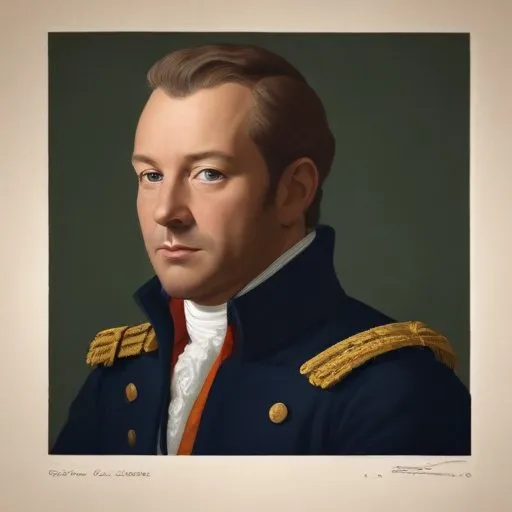
Led the third expedition to circumnavigate the globe, achieving this remarkable feat in 1588 and becoming the first Englishman to do so. He paved the way for future explorers and opened up new trade routes.
Thomas Cavendish, a fearless English explorer and privateer, etched his name in history by becoming the first to intentionally circumnavigate the globe, raiding Spanish towns and ships in the Pacific, and returning home with a treasure trove of riches. This daring feat earned him the nickname "The Navigator" and the admiration of his contemporaries, including Queen Elizabeth I, who knighted him for his bravery.
Born in 1560, Cavendish was baptized in St. Martin's Church, Trimley St. Martin, Suffolk. As the third son of William Cavendish and Mary Wentworth, he inherited a sizeable estate after his father's death in 1572. Under the guardianship of Thomas Wentworth, 2nd Baron Wentworth, Cavendish was prepared for a university education, attending Corpus Christi College, Cambridge, and later Gray's Inn, London.
At just 26 years old, Cavendish embarked on his first circumnavigation voyage, inspired by the expeditions of Sir Francis Drake and others. He set sail on July 21, 1586, with three ships, the Desire, the Content, and the Hugh Gallant. During this journey, he captured several Spanish ships, including the Manila Galleon Santa Ana, which yielded a staggering haul of gold, silk, and other treasures.
Cavendish's first voyage was a resounding success, and he returned to England on September 9, 1588, with a wealth of riches and acclaim. His feat earned him a hero's welcome, and Queen Elizabeth I knighted him for his bravery and skill. This triumph also brought him financial success, with his captured treasure making him a wealthy man.
Undeterred by his initial success, Cavendish set out on a second circumnavigation voyage in 1591, seeking to repeat his earlier accomplishments. However, this expedition was plagued by misfortune, including the loss of ships and crew members. Cavendish himself died at sea in 1592, at the age of 31, his dreams of further glory and riches left unfulfilled.
Despite his tragic demise, Thomas Cavendish's achievements left an indelible mark on the world of exploration and navigation. His bold endeavors inspired future generations of explorers, and his name remains synonymous with bravery and adventure.
In conclusion, Thomas Cavendish's remarkable story continues to captivate and inspire, reminding us of the importance of pushing boundaries, taking risks, and striving for greatness.
Born in 1552
A Renaissance man who wrote poetry, fought in wars, and explored the New World, introducing potatoes and tobacco to England. He's famous for his daring exploits and romanticized legend.
79 Years Old
Australian Labor Party politician who served as Treasurer of Australia from 1983 to 1991, implementing significant economic reforms. He is credited with modernizing the Australian economy.
Born in 1542
A daring sea captain and privateer who raided Spanish ships and colonies, known for his bravery and cunning during the Elizabethan era.
Born in 1574
An English explorer and cartographer who mapped the New World and created innovative navigational tools, contributing significantly to the development of modern cartography.
Born in 1787
The 14th Governor of Massachusetts, a Whig politician who served from 1834 to 1835 and later became a prominent lawyer, is most known for his brief but significant tenure in the state's highest office. He played a key role in shaping Massachusetts' early development and politics.
