


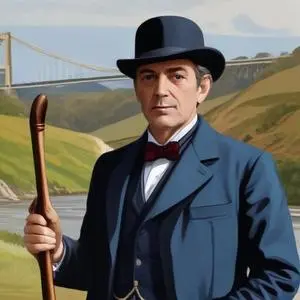
A Scottish architect and engineer renowned for designing iconic bridges, including the Menai Suspension Bridge, which revolutionized transportation and connected communities.
Thomas Telford was a Scottish civil engineer who left an indelible mark on the world of infrastructure development, earning him the nickname "The Colossus of Roads." With a prolific career spanning over five decades, he designed and built numerous roads, canals, harbors, and tunnels, cementing his reputation as one of the most influential engineers of the 19th century.
Born on August 9, 1757, in Glendinning, Scotland, Telford's early life was marked by poverty and hardship. After his father's death, he was raised by his mother, Janet Jackson, and was apprenticed to a stonemason at the age of 14. His early work can still be seen on the bridge across the River Esk in Langholm, Dumfries and Galloway.
In 1782, Telford moved to London, where he worked on building additions to Somerset House, meeting prominent architects Robert Adam and Sir William Chambers. His talents soon expanded to specifying, designing, and managing building projects, despite being largely self-taught.
In 1787, Telford became the Surveyor of Public Works in Shropshire, thanks to his wealthy patron, William Pulteney. This appointment marked the beginning of his illustrious career, during which he renovated Shrewsbury Castle, built the Church of St. Mary Magdalene in Bridgnorth, and constructed another church in Madeley.
Telford's work in Shropshire led to his involvement in numerous infrastructure projects, including roads, canals, and harbors. His reputation as a master engineer spread far and wide, earning him the respect of his peers and the admiration of the public.
In 1818, Telford was elected as the first president of the Institution of Civil Engineers, a post he held for 14 years until his death. This institution, founded by Telford and other prominent engineers, aimed to promote the development of civil engineering and provide a platform for engineers to share knowledge and best practices.
Telford's legacy extends far beyond his impressive engineering feats. The town of Telford in Shropshire was named after him, and he is still revered as one of the greatest engineers of all time.
In recognition of his contributions, Telford was awarded numerous honors, including a commemorative bust in Westminster Abbey and a statue in his hometown of Eskdalemuir.
Telford remained a bachelor throughout his life, dedicating himself to his work and leaving behind a legacy that continues to inspire generations of engineers and architects.
He passed away on September 2, 1834, leaving behind a testament to his ingenuity, creativity, and perseverance.
Thomas Telford's life and work serve as a testament to the power of human ingenuity and creativity. His contributions to the world of engineering continue to inspire and influence modern infrastructure development, solidifying his place as one of the greatest engineers of all time.
Born in 1806
A visionary engineer who revolutionized transportation with innovative designs, including the iconic Clifton Suspension Bridge, which transformed urban landscapes.
Born in 1781
Designed the Liverpool and Manchester Railway, a pioneering feat that revolutionized transportation and paved the way for modern rail networks.
Born in 1791
Pioneering scientist who discovered electromagnetic induction, formulated the laws of electrolysis, and invented the first electrical generator, revolutionizing our understanding of electricity and its applications.
Born in 1736
Improved steam engine efficiency, revolutionizing industry and transportation. Known for his innovative designs and patents that transformed the Industrial Revolution.
56 Years Old
A Zimbabwean cricketer who played 13 Tests and 44 ODIs, known for his right-arm medium-fast bowling and lower-order batting.
Born in 1771
Built steam-powered locomotives, revolutionizing land transportation, and pioneered the use of steam engines in mines.
Born in 1724
A renowned engineer who designed iconic bridges, revolutionizing transportation infrastructure in the 18th century. His innovative designs still inspire modern architecture today.
Born in 1773
Designed and built the first successful glider, pioneering modern aeronautical engineering, and is often credited with inventing the first powered, heavier-than-air aircraft.
