


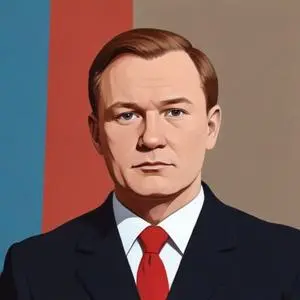
The first leader of the United Nations, instrumental in shaping the organization's early years and promoting international cooperation. Known for his efforts to maintain world peace and security during the Cold War era.
Trygve Halvdan Lie was a Norwegian politician, labour leader, and government official who left an indelible mark on the world stage as the first Secretary-General of the United Nations. From 1946 to 1952, Lie navigated the complexities of international diplomacy, guiding the fledgling organization through its formative years and setting the tone for its future endeavors.
Born on July 16, 1896, in Kristiania (now Oslo), Norway, Lie grew up in humble circumstances. His father, Martin Lie, abandoned the family in 1902 to seek his fortunes in the United States, leaving Trygve, his mother Hulda, and sister to fend for themselves. Despite these challenges, Lie's mother ran a boarding house and café in Grorud, where Trygve developed strong social skills and a keen sense of responsibility.
Lie's entry into politics began in 1911, when he joined the Labour Party. His dedication and charisma soon earned him the position of national secretary, which he held until 1919. During this period, he edited the journal Det 20de Aarhundre (The 20th Century) from 1919 to 1921. Lie's law degree from the University of Oslo in 1919 further solidified his standing within the party.
As a legal consultant for the Norwegian Confederation of Trade Unions from 1922 to 1935, Lie became renowned for his ability to settle disputes and bring pivotal cases before the courts. This expertise earned him the chairmanship of the Norwegian Workers' Confederation of Sports from 1931 to 1935. Lie's commitment to the labour movement was further demonstrated by his role as a member of the executive committee of Aker municipality council from 1922 to 1931.
In 1935, Lie's political career took a significant turn when he was appointed Minister of Justice in the Labour Party government formed by Johan Nygaardsvold. He later served as Minister of Trade from July to October 1939 and Minister of Supplies from October 1939 to 1941.
Lie's exposure to international diplomacy began during World War II, when he played a crucial role in the Norwegian government-in-exile in London from 1940 to 1945. It was during this period that he forged strong relationships with world leaders, including Winston Churchill, and demonstrated his capacity for effective crisis management.
In 1946, Lie's reputation as a skilled diplomat and mediator earned him the distinction of becoming the first Secretary-General of the United Nations. During his tenure, he navigated the complexities of post-war reconstruction, guided the organization through the 1947 Partition Plan for Palestine, and played a pivotal role in shaping the United Nations' early years.
Trygve Lie's legacy extends far beyond his time at the United Nations. His commitment to international cooperation, conflict resolution, and social justice has inspired generations of diplomats and world leaders. As a pioneer in the field of international diplomacy, Lie's contributions have had a lasting impact on modern society, shaping the course of global affairs and informing the work of the United Nations to this day.
Awarded the Grand Cross of the Order of St. Olav in 1948, Lie's dedication to public service was recognized and respected by his peers and the international community. His life's work serves as a testament to the power of diplomacy, cooperation, and the unwavering pursuit of peace and justice.
Born in 1905
A Swedish economist and diplomat who served as the 2nd Secretary-General of the United Nations, promoting international cooperation and peace, and posthumously awarded the Nobel Peace Prize. He's known for his tireless efforts to resolve global conflicts and promote humanitarian causes.
Born in 1909
A Burmese educator and diplomat who served as the 3rd United Nations Secretary-General, mediating international conflicts and promoting global cooperation. He's known for his quiet diplomacy and leadership during the Cold War era.
Born in 1918
An Austrian colonel and politician who served as the 9th President of Austria, known for his controversial past as a Nazi officer during World War II. He was also the Secretary-General of the United Nations from 1972 to 1981.
Born in 1920
A Peruvian politician and diplomat who served as the 135th Prime Minister of Peru and later became the fifth Secretary-General of the United Nations, playing a key role in international diplomacy and conflict resolution.
Born in 1922
The first Arab to lead the United Nations, he played a key role in shaping international relations and global governance during a tumultuous period in the 1990s. He's also known for his efforts to reform the UN and promote peacekeeping operations.
88 Years Old
A renowned international diplomat who led the United Nations from 1997 to 2006, promoting global cooperation and development, and receiving the Nobel Peace Prize in 2001.
81 Years Old
The 8th Secretary-General of the United Nations, a South Korean politician and diplomat who played a crucial role in promoting global peace, security, and sustainable development. He's known for his efforts to combat climate change and advocate for human rights.
77 Years Old
The first Portuguese to lead the United Nations, he's a champion of global cooperation, human rights, and sustainable development. He's a prominent voice on the world stage, advocating for climate action and social justice.
