


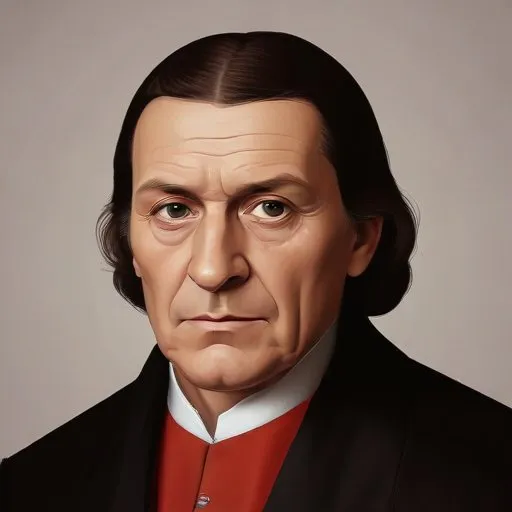
A German knight and scholar who played a key role in the Protestant Reformation, advocating for church reform and criticizing corruption within the Catholic Church.
Ulrich von Hutten, a luminary of the German Renaissance, left an indelible mark on the annals of history as a knight, scholar, poet, and satirist. As an ardent follower of Martin Luther, he played a pivotal role in the Protestant Reformation, fearlessly critiquing the Roman Catholic Church and championing the cause of reform.
Born on April 21, 1488, in Steckelberg Castle, Hesse, Hutten was destined for a life of piety and learning. His early years were spent in the Benedictine monastery in Fulda, where he received an excellent education, but ultimately fled to Cologne in 1505 to escape the confines of monastic life.
In Cologne, Hutten embarked on a journey of intellectual exploration, befriending scholars and poets like Hoogstraten and Johannes Rhagius. His academic pursuits took him to Erfurt, Frankfurt an der Oder, and Leipzig, where he earned his master's degree and published his first poem.
Hutten's scholarship and poetry reflected his deep-seated desire for reform. He penned scathing satires against the Roman Catholic Church, earning him both praise and persecution. As a key figure in the Protestant Reformation, he worked closely with Martin Luther, leveraging his connections to disseminate Luther's ideas to a broader audience.
Hutten's influential writings bridged the gap between Renaissance humanism and the Lutheran Reformation, infusing the Protestant movement with a sense of intellectual rigor and literary flair. His most famous work, Equivocus, a biting satire, remains a testament to his unwavering commitment to reform.
In 1519, Hutten became embroiled in the Knights' War, a rebellion led by Franz von Sickingen, aimed at reforming the Holy Roman Empire. Alongside Sickingen, Hutten rallied the knights, using his poetic talents to galvanize support for their cause.
As the Protestant Reformation gained momentum, Hutten's role evolved from satirist to reformer. He passionately advocated for Luther's principles, using his writings to spread the message of reform and promote understanding between Catholics and Protestants.
Hutten's remarkable life, marked by intellectual curiosity, poetic genius, and unwavering commitment to reform, has left an enduring legacy. His work not only influenced the course of the Protestant Reformation but also helped shape the cultural and literary landscape of Germany.
Through his writings, Hutten inspired generations of scholars, poets, and reformers, cementing his place as one of the most fascinating figures of the Renaissance and Reformation era.
Born in 1483
A German monk and priest who sparked the Protestant Reformation, challenging Catholic Church authority and shaping Western Christianity. He's famous for nailing 95 theses to a church door, sparking a religious revolution.
Born in 1497
A 16th-century Renaissance scholar who made significant contributions to the development of the Protestant Reformation and education, known for his theological writings and astronomical observations.
Born in 1509
A French pastor and theologian who played a key role in the Protestant Reformation, shaping Christian theology and influencing Western civilization. He's famous for his teachings on predestination and his role in establishing Calvinism.
Born in 1484
Leader of the Swiss Reformation, advocating for church reform and inspiring other Protestant movements.
Born in 1499
A prominent figure in the Protestant Reformation, this theologian played a key role in shaping Lutheran theology and was a close associate of Martin Luther. He's also known for his biblical commentaries and liturgical reforms.
