


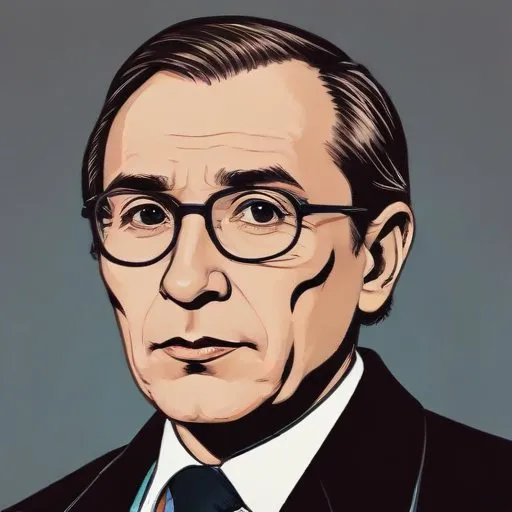
Russian physicist and academic who made significant contributions to the development of quantum field theory and the Standard Model of particle physics. He is also known for his work on neutrino physics and cosmology.
Vadim Alekseyevich Kuzmin, a renowned Russian theoretical physicist, is best known for his groundbreaking predictions and contributions to the fields of particle astrophysics, cosmology, and baryogenesis. His most notable work includes the prediction of the GZK limit for cosmic rays and his pioneering research on electroweak baryogenesis.
Kuzmin completed his undergraduate studies in 1961 at Moscow State University and went on to earn his Ph.D. in 1971 at Lebedev Institute. He then joined the Institute for Nuclear Research in Moscow, where he became a professor and chair of the department of particle astrophysics and cosmology.
Kuzmin's work has had a profound impact on our understanding of the universe. Some of his notable contributions include:
Kuzmin's work has been recognized with several prestigious awards, including:
Kuzmin's work has left an indelible mark on the field of theoretical physics. His predictions and contributions have paved the way for further research and discoveries, and his legacy continues to inspire new generations of physicists.
Born in 1921
A Soviet physicist and dissident who advocated for human rights and nuclear disarmament, earning a Nobel Peace Prize in 1975. He's known for his courageous stance against the Soviet regime, promoting peace and democracy.
Born in 1908
A renowned physicist and academic who made groundbreaking contributions to our understanding of quantum mechanics, superfluidity, and particle physics, earning a Nobel Prize in Physics in 1962.
Born in 1909
Developed mathematical methods for quantum field theory and made significant contributions to the development of theoretical physics, particularly in the areas of statistical mechanics and quantum mechanics.
Born in 1895
A Soviet physicist who developed the concept of the "tokamak," a device used to confine and study plasmas at extremely high temperatures, leading to advancements in nuclear fusion research.
Born in 1908
A Soviet physicist who discovered and explained the phenomenon of Cherenkov radiation, a crucial finding in particle physics. This discovery led to the development of new methods for detecting and studying subatomic particles.
Born in 1916
A Soviet physicist who made groundbreaking contributions to the theory of superconductivity and superfluidity, earning him the Nobel Prize in Physics in 2003.
Born in 1919
A Soviet general and engineer who designed the iconic AK-47 assault rifle, a weapon that has become a symbol of revolution and conflict around the world.
