


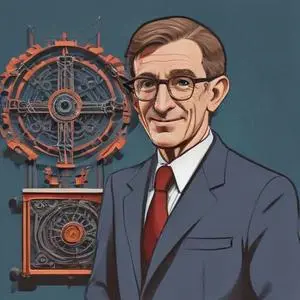
Developed the concept of the internet's precursor, hypertext, and advocated for government funding of scientific research, shaping modern computing and innovation.
Vannevar Bush, a pioneering American engineer, inventor, and science administrator, is best known for his work on analog computers, the development of the memex, and his leadership in the U.S. Office of Scientific Research and Development (OSRD) during World War II.
Bush's contributions to science and technology were far-reaching, with a string of patented inventions and groundbreaking research in the fields of electrical engineering and computer science. His work on analog computers, including the development of the differential analyzer, paved the way for digital circuit design theory.
In the 1930s, Bush conceptualized the memex, a hypothetical adjustable microfilm viewer with a structure analogous to that of hypertext. This innovative idea influenced generations of computer scientists and foreshadowed the development of the internet.
Bush's leadership skills and expertise in science administration led to his appointment as chairman of the National Advisory Committee for Aeronautics (NACA) in 1938. He later became the director of the OSRD, overseeing the coordination of scientific research and development during World War II.
Under Bush's direction, the OSRD played a crucial role in the development of radar and the initiation of the Manhattan Project. His emphasis on the importance of scientific research to national security and economic well-being helped shape the nation's approach to science policy.
Bush received numerous awards and honors for his contributions to science and engineering, including the National Medal of Science, the Presidential Medal of Freedom, and the IRI Medal.
Born on March 11, 1890, in Everett, Massachusetts, Bush earned his bachelor's degree in electrical engineering from Tufts College in 1913. He went on to earn his Ph.D. in electrical engineering from Harvard University in 1916.
Bush joined the Department of Electrical Engineering at the Massachusetts Institute of Technology (MIT) in 1919 and later became the vice president of MIT and dean of the MIT School of Engineering. He also served as the president of the Carnegie Institution of Washington from 1938 to 1955.
Bush was a strong advocate for the importance of basic scientific research and its potential to improve society. His 1945 essay, "As We May Think," emphasized the need for scientists to communicate more effectively and highlighted the potential of technology to augment human thought.
Bush's work and ideas have had a profound impact on modern society, influencing the development of digital computers, the internet, and the way we think about information and communication.
Bush's personal life was marked by a strong sense of duty and service to his country. He served in the U.S. Navy during World War I and was a member of the National Academy of Sciences.
Bush was married to Phoebe Davis and had two sons, Richard and John. He passed away on June 28, 1974, at the age of 84, leaving behind a legacy of innovation and public service.
Vannevar Bush's contributions to science, technology, and society have had a lasting impact on modern society. His vision, leadership, and innovative spirit continue to inspire generations of scientists, engineers, and thinkers.
Born in 1882
Led the United States through the Great Depression and World War II, implementing a series of reforms known as the New Deal and helping to establish the country as a global superpower.
Born in 1884
The 33rd President of the United States, a strong leader who made tough decisions, including dropping atomic bombs on Japan and establishing the Marshall Plan to rebuild Europe after WWII.
Born in 1890
Led the Allied forces to victory in World War II and later served as President, maintaining peace and prosperity during the Cold War era. He's known for his strategic leadership and diplomatic skills.
Born in 1917
The 35th President of the United States was a charismatic leader who navigated the country through the Cuban Missile Crisis and advocated for civil rights, leaving a lasting legacy in American politics.
Born in 1908
The 36th President of the United States, a skilled politician and leader, played a crucial role in passing landmark civil rights legislation, including the Civil Rights Act and Voting Rights Act.
Born in 1913
The 37th President of the United States, a polarizing figure who led the country through significant domestic and foreign policy changes, infamous for his involvement in the Watergate scandal.
Born in 1895
The first Director of the FBI, who led the agency for nearly five decades, building it into a powerful force in American law enforcement, and notorious for his secretive and authoritarian style. He's infamous for his surveillance and harassment of political dissidents, civil rights leaders, and celebrities.
Born in 1912
Pioneering mathematician and computer scientist who cracked the German Enigma code during WWII and laid the foundations for modern computer science and artificial intelligence.
