


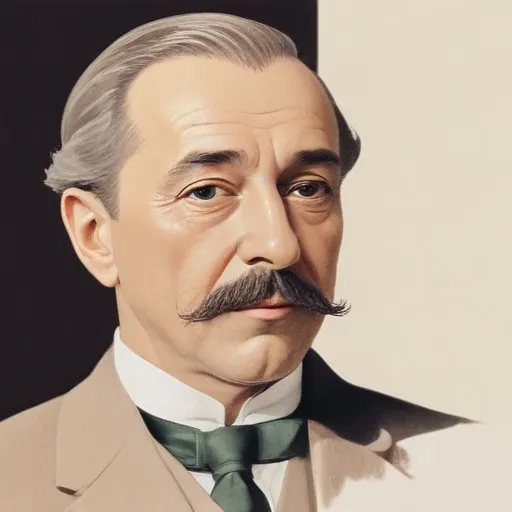
Victor Horta, the renowned Belgian architect and designer, is widely regarded as one of the founders of the Art Nouveau movement. His innovative and ornate designs, which often featured curving, organic lines and a sense of fluidity, would go on to influence generations of architects and designers.
Horta was born in Ghent, Belgium on January 6, 1861, to a family of modest means. His father, a master shoemaker, instilled in him a deep appreciation for craftsmanship and attention to detail. This would later become a hallmark of Horta's own work.
In the late 19th century, Horta's designs began to gain international attention, particularly his iconic Hôtel Tassel in Brussels. Completed in 1893, the Hôtel Tassel is often cited as the first true Art Nouveau building, with its sinuous lines, flowing curves, and organic forms.
Horta's work was heavily influenced by the French architectural theorist Eugène Viollet-le-Duc, and he was particularly drawn to the idea of creating buildings that were harmonious with their surroundings. This approach would become a central tenet of the Art Nouveau movement.
Horta was also a pioneer in the use of new materials and techniques, including the innovative use of iron, steel, and glass. His designs often featured open floor plans, skylights, and large windows, which allowed for an unprecedented amount of natural light to flood into the interior spaces.
One of Horta's most significant contributions to the field of architecture was his development of the "open plan" concept, where interior walls were eliminated to create a sense of fluidity and openness. This approach would go on to influence modern architecture and urban planning.
In 1932, King Albert I conferred upon Horta the title of Baron, in recognition of his services to the field of architecture. Four of Horta's buildings in Brussels were added to the UNESCO World Heritage List in 2000, solidifying his legacy as one of the most important architects of the 20th century.
Viktor Horta's innovative designs, pioneering use of materials and techniques, and his influence on modern architecture have cemented his place as one of the most important architects of the 20th century. His work continues to inspire and delight, a testament to his enduring legacy in the world of architecture and design.
Born in 1814
A French architect who restored and designed Gothic Revival buildings, including the iconic Lausanne Cathedral, leaving a lasting mark on European architecture.
Born in 1868
A pioneering figure in the Glasgow School of Art, this visionary blended elegant lines, flowing curves, and organic forms to create iconic furniture, textiles, and buildings that epitomize Art Nouveau style.
Born in 1856
Designed iconic buildings that blended functionality with ornate details, revolutionizing American architecture with his innovative "form follows function" philosophy.
Born in 1867
Visionary architect behind iconic, harmonious structures that blend seamlessly into their surroundings, redefining modern American architecture.
Born in 1832
Co-designer of the iconic Eiffel Tower, a pioneering engineer who revolutionized bridge building and urban infrastructure with innovative iron constructions.
Born in 1869
A pioneering artist who revolutionized modern art with bold, expressive, and colorful works that blurred the lines between painting and sculpture, creating a new language of form and color.
