


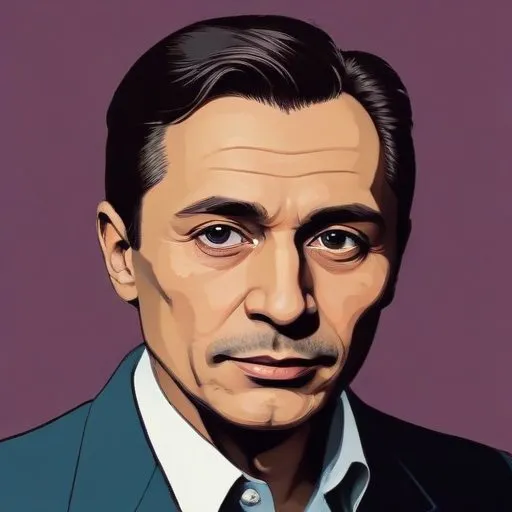
A postmodernist writer blending philosophy, mysticism, and dark humor, known for surreal and thought-provoking novels that critique modern society.
Victor Pelevin is a renowned Russian fiction writer, celebrated for his multilayered, postmodernist novels that seamlessly blend elements of pop culture, esoteric philosophies, and science fiction. His works, such as Omon Ra, The Life of Insects, and Generation P, have garnered him numerous literary awards, including the Russian Little Booker Prize and the Russian National Bestseller.
Pelevin was born on November 22, 1962, in Moscow to Zinaida Semenovna Efremova, an English teacher, and Oleg Anatolyevich Pelevin, a teacher at the military department of Bauman University. He spent his childhood on Tverskoy Boulevard in Moscow and later moved to Chertanovo.
Pelevin's educational background is a testament to his intellectual curiosity. He graduated from an elite high school with a special English program in 1979 and then attended the Moscow Power Engineering Institute (MPEI), where he earned a degree in electromechanical engineering in 1985. He also served in the Russian Air Force and attended the MPEI graduate school from 1987 to 1989.
Pelevin's writing career began in the 1990s, during which he published several critically acclaimed novels and short stories. His debut novel, Omon Ra (1992), explores the intersection of science fiction and Soviet reality. This was followed by The Life of Insects (1993), which delves into the realm of human consciousness and the nature of reality.
In 1996, Pelevin published Chapayev and Void, a novel that blends historical and philosophical themes. His magnum opus, Generation P (1999), is a sweeping narrative that critiques Russian society and politics during the 1990s.
Pelevin's works are infused with philosophical and esoteric themes. While he does not identify as a Buddhist, he has been influenced by Buddhist practices and has traveled extensively to Asia. His writing often explores the nature of reality, consciousness, and human existence.
Pelevin's literary prowess has been recognized with numerous awards and nominations. He was awarded the Russian Little Booker Prize in 1993 for his short story collection The Blue Lantern. In 2004, he won the Russian National Bestseller award. In 2011, he was nominated for the Nobel Prize in Literature.
Pelevin is known for his reclusive nature and has shied away from public attention. Despite this, he has been open about his travels to Asia and his interest in Eastern philosophies. He has visited Nepal, South Korea, China, and Japan, and has been fascinated by the cultural and spiritual heritage of these countries.
Pelevin's influence on modern Russian literature cannot be overstated. His unique blend of science fiction, philosophy, and social commentary has inspired a new generation of writers and thinkers. His works continue to be widely read and studied, both in Russia and around the world.
"The most important thing in life is to stop saying 'I wish' and start saying 'I will.'"
"Reality is like a novel, and we are all just characters in it."
"The only way to understand the world is to understand yourself."
Pelevin's writing style has been likened to that of Thomas Pynchon, Don DeLillo, and Haruki Murakami. His unique blend of postmodernism, science fiction, and philosophical inquiry has set him apart from his contemporaries and solidified his position as a literary innovator.
Victor Pelevin's remarkable literary career is a testament to his boundless creativity and intellectual curiosity. As a writer, philosopher, and cultural commentator, he continues to inspire and challenge readers around the world.
Born in 1899
A Russian-born novelist and critic, renowned for crafting intricate, lyrical prose and exploring themes of identity, morality, and the human condition through works like "Lolita" and "Pale Fire".
Born in 1821
A Russian literary mastermind who penned psychologically complex novels that probed the human condition, exploring themes of morality, philosophy, and the darker aspects of human nature.
Born in 1828
A Russian literary giant who penned sweeping novels like "War and Peace" and "Anna Karenina", exploring the human condition with profound insight and masterful storytelling.
Born in 1860
A renowned Russian literary mastermind, celebrated for crafting poignant, psychologically nuanced tales that probe the human condition, and pioneering the modern short story genre.
Born in 1880
A Russian literary giant, known for pioneering the avant-garde movement in literature, blending poetry and prose to create innovative, symbolic works that explored the human experience.
Born in 1893
A Russian avant-garde artist who revolutionized poetry and theater with his bold, futuristic style and passionate performances. He's most famous for his vibrant, propaganda-inspired posters and poems that captured the spirit of the Russian Revolution.
Born in 1899
A Soviet writer and poet, known for his unique blend of realism and mysticism, exploring the human condition and the Russian Revolution in his works. His writing often blurred the lines between poetry and prose, creating a distinctive style.
Born in 1891
A Russian literary mastermind, famous for blending fantasy and realism in works like "The Master and Margarita", which explores the intersection of politics, philosophy, and the human condition.
