


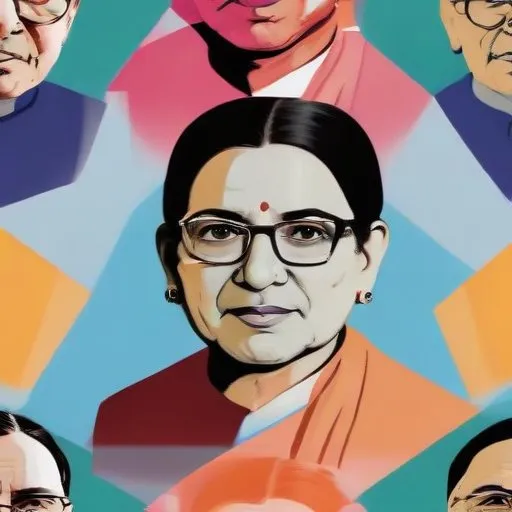
Indian Minister of External Affairs who served from 1969 to 1970 and played a key role in shaping India's foreign policy during the Cold War era. He was also a prominent figure in Indian politics, holding various cabinet positions.
Vidya Charan Shukla was a prominent Indian politician who left an indelible mark on the country's political landscape. He is best known for his six-decade-long career, during which he held various ministerial positions, including Minister of State with Independent Charge of Information and Broadcasting under Prime Minister Indira Gandhi's government.
Vidya Charan Shukla was born on August 2, 1929, in Raipur, India. His father, Ravishankar Shukla, was a lawyer and a politician who served as the first Chief Minister of Madhya Pradesh. Shukla's older brother, Shyama Charan Shukla, was also a prominent politician who served as the Chief Minister of Madhya Pradesh. Vidya Charan Shukla graduated from Morris College, Nagpur in 1951.
Shukla's political career began in 1957 when he was elected as a Member of Parliament in the Lok Sabha from the Balodabazar constituency on an Indian National Congress ticket. At the age of 28, he became one of the youngest MPs in the 2nd Lok Sabha. He went on to win Lok Sabha elections from Mahasamund in 1962, 1964, 1967, 1980, 1984, and 1989, and from Raipur in 1971 and 1991.
During his political career, Shukla was a member of various political parties, including the Indian National Congress, Jan Morcha, Janata Dal, Samajwadi Janata Party (Rashtriya), Nationalist Congress Party, and Bharatiya Janata Party. He served as a Minister in Indira Gandhi's cabinet from 1967 to 1977, including as Minister of State with Independent Charge of Information and Broadcasting.
Shukla's tenure as Minister of Information and Broadcasting during the Emergency period (1975-1977) was marked by controversy. His ministry attracted criticism for its media censor policy, which was seen as an attempt to suppress freedom of speech. This period has been a subject of debate among historians and politicians, with some viewing it as a necessary step to maintain law and order, while others saw it as an attack on democratic values.
Vidya Charan Shukla's six-decade-long political career was marked by both achievements and controversies. Despite the criticisms, he remains a significant figure in Indian politics, and his contributions to the country's development cannot be ignored. His legacy serves as a reminder of the complexities of Indian politics and the need for nuanced understanding of historical events.
Vidya Charan Shukla was awarded the Padma Bhushan, one of India's highest civilian honors, in 1992.
In conclusion, Vidya Charan Shukla's life and career serve as a testament to the complexities of Indian politics and the importance of nuanced understanding of historical events. Despite the controversies, he remains an important figure in Indian political history, and his contributions to the country's development continue to inspire generations of politicians and citizens alike.
Born in 1924
A renowned Indian poet and politician who served as the country's 10th Prime Minister, known for his efforts to strengthen India's economy and improve relations with neighboring countries.
81 Years Old
The 6th Prime Minister of India, a key figure in Indian politics, known for introducing economic reforms and promoting technology in the country. He was also a strong advocate for social justice and equality.
79 Years Old
The first female President of the Indian National Congress, leading the party to a landslide victory in 2004, and playing a crucial role in shaping India's political landscape.
93 Years Old
The 13th Prime Minister of India, a renowned economist who led the country through a period of rapid economic growth and liberalization, implementing reforms that transformed India's economy. He is credited with helping to lift millions of people out of poverty.
90 Years Old
The 13th President of India, a seasoned politician and journalist, served as the head of state from 2012 to 2017, playing a key role in shaping the country's economy and foreign policy. He's known for his diplomatic skills and ability to build consensus.
Born in 1917
The first female Prime Minister of India, serving from 1966 to 1977 and again from 1980 until her assassination in 1984, known for her strong leadership and economic reforms.
Born in 1889
India's first Prime Minister, a key figure in the country's struggle for independence from British rule, and a champion of democracy and secularism. He played a crucial role in shaping modern India's government and economy.
Born in 1884
India's first president, a key figure in the country's struggle for independence, who played a crucial role in shaping the nation's early years. He's revered for his leadership and commitment to democracy.
