


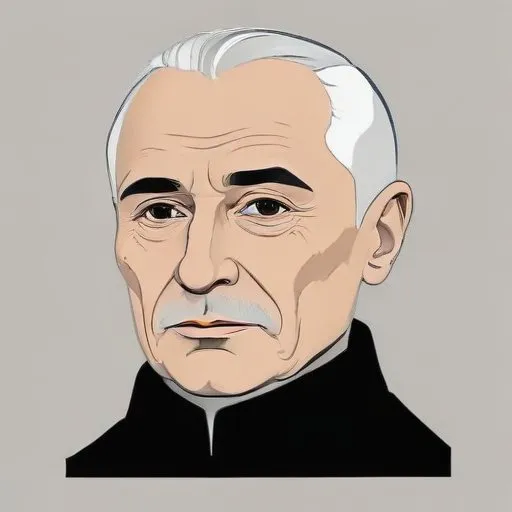
A Russian painter and architect who designed sets and costumes for the Imperial Russian Opera and Ballet, and inspired Modest Mussorgsky's famous composition "Pictures at an Exhibition".
Viktor Hartmann was a Russian architect and painter, best known for his vibrant watercolors and pencil drawings that inspired Modest Mussorgsky's iconic composition, Pictures at an Exhibition. His unique style, which combined traditional Russian motifs with modern techniques, has left an indelible mark on the world of art and music.
Hartmann was born on May 5, 1834, in Saint Petersburg, Russia, to a family of German ancestry. After being orphaned at a young age, he was raised by his mother's sister and her husband, Alexandre Hemilian, a well-known architect. This early exposure to architecture would later influence his career path.
Hartmann initially studied at the Academy of Fine Arts in Saint Petersburg, where he honed his skills as an illustrator and book designer. He later shifted his focus to architecture, eventually designing the monument to the thousandth anniversary of Russia in Novgorod, which was inaugurated in 1862.
In the mid-1860s, Hartmann embarked on a series of journeys abroad, during which he created a plethora of watercolors and pencil drawings. These works showcased his fascination with traditional Russian motifs, which he blended with modern techniques to create a unique style.
In 1870, Hartmann's friend Vladimir Stasov introduced him to composer Modest Mussorgsky. This encounter would have a profound impact on Mussorgsky's work, as Hartmann's paintings inspired the composer to create his iconic suite, Pictures at an Exhibition.
Tragically, Hartmann's life was cut short when he died of an aneurysm in 1873, at the age of 39. In response to his friend's passing, Mussorgsky composed his masterpiece, which premiered in 1874.
The exhibition of Hartmann's works at the Academy of Fine Arts in Saint Petersburg in 1874 was a testament to his artistic prowess. Although many of his original works have been lost, his legacy lives on through Mussorgsky's composition, which continues to inspire artists and musicians to this day.
Despite his short-lived career, Viktor Hartmann's impact on the world of art and music is undeniable. His vibrant watercolors and pencil drawings continue to inspire generations of artists, and his legacy lives on through Mussorgsky's masterpiece, Pictures at an Exhibition.
Born in 1848
A Russian master of historical scenes, capturing the grandeur and drama of 16th- to 18th-century Russia with vivid colors and meticulous details.
Born in 1844
A Russian master of realism, known for vivid depictions of Russian life and history, capturing the essence of the human experience through his brushstrokes.
Born in 1842
A master of light and atmosphere, this Ukrainian-Russian painter is renowned for his breathtaking landscapes that evoke a sense of mystique and drama.
Born in 1830
A Russian painter and academic who created landscapes that evoked a sense of melancholy and nostalgia, capturing the beauty of the Russian countryside. He's particularly famous for his painting "The Rooks Have Returned" which is considered an iconic representation of Russian art.
Born in 1860
A Russian painter and illustrator renowned for capturing the serene beauty of landscapes and the fleeting effects of light, evoking a sense of melancholy and nostalgia.
Born in 1856
A Russian Symbolist painter who created vibrant, dreamlike works that blended fantasy and reality, often featuring mythical creatures and folklore-inspired themes.
