


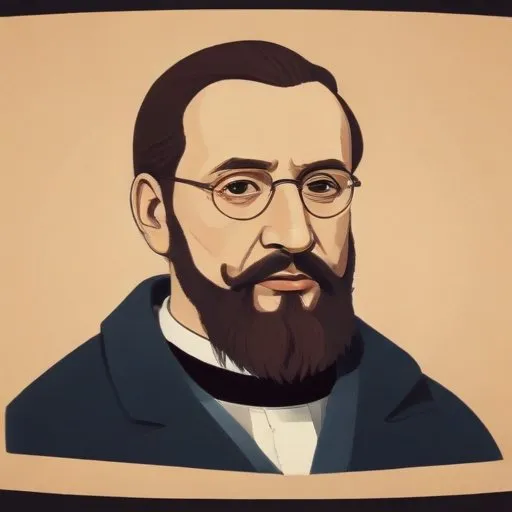
A 17th-century Italian polymath who made significant contributions to mathematics, astronomy, and physics, particularly in the fields of geometry and optics. He's also known for being a student of Galileo Galilei.
Vincenzo Viviani was a 17th-century Italian mathematician and scientist who left an indelible mark on the world of mathematics and science. He is widely regarded as one of the most prominent disciples of Galileo Galilei and Evangelista Torricelli, and his contributions to the fields of geometry, physics, and mathematics continue to inspire and influence scholars to this day.
Viviani was born on April 5, 1622, in Florence, Italy, to Jacopo di Michelangelo Viviani and Maria Alamanno del Nente. His early education was rooted in the humanities, which he studied at a Jesuit school. However, it was not until he turned to mathematics that he discovered his true calling.
Viviani's talent and dedication caught the attention of Clemente Settimi, a Galilean follower, who introduced him to the renowned mathematician and scientist, Famiano Michelini. This chance encounter led to Viviani meeting Galileo Galilei, with whom he would collaborate on several groundbreaking projects.
In 1638, Viviani was introduced to Galileo, who was impressed by the young mathematician's skills and offered him a monthly salary to continue his education. This marked the beginning of a fruitful collaboration that would change the course of Viviani's life.
Viviani's work with Galileo on "Two New Sciences" was instrumental in shaping his understanding of the acceleration of free bodies along an inclined plane. This collaboration not only deepened Viviani's knowledge of mathematics but also inspired him to apply mathematical principles to the natural world.
After Galileo's death in 1642, Viviani continued to work with Evangelista Torricelli, with whom he explored the realms of physics and geometry. This partnership led to significant contributions to the field of mathematics, including Viviani's own work on the geometry of curves.
Viviani's legacy extends far beyond his mathematical contributions. He was appointed to fill Torricelli's position at the Accademia dell'Arte del Disegno in Florence, where he continued to inspire and educate future generations of mathematicians and scientists.
Today, Viviani's work remains a testament to the power of mathematical inquiry and the importance of collaboration in driving scientific progress. Despite being overshadowed by his more famous contemporaries, Viviani's contributions to mathematics and science continue to influence scholars and inspire new discoveries.
Viviani's work was deeply rooted in the philosophy of nature, which he believed could be understood and explained through mathematical principles. His collaboration with Galileo and Torricelli instilled in him a deep appreciation for the interconnectedness of mathematics and the natural world.
Viviani's contributions to mathematics and science have had a lasting impact on modern society. His work on the geometry of curves has influenced fields such as engineering, physics, and computer science, while his emphasis on the importance of mathematical inquiry has inspired generations of scholars and researchers.
Born in 1564
Pioneering astronomer, physicist, and mathematician who played a major role in the Scientific Revolution, making key discoveries that challenged Aristotelian views and laid the foundation for modern science.
Born in 1608
Developed the mercury barometer, a device that measures atmospheric pressure, and made significant contributions to the study of vacuums and fluids.
Born in 1588
A 17th-century polymath who made significant contributions to mathematics, particularly in the discovery of prime numbers, and wrote extensively on philosophy and theology.
Born in 1623
A 17th-century genius who made major contributions to mathematics, physics, and philosophy, inventing the mechanical calculator and developing the theory of probability. His writings also explored the human condition and faith.
Born in 1596
Developed influential philosophical and mathematical concepts, including the famous phrase "I think, therefore I am," and laid the foundation for modern Western philosophy.
Born in 1629
A 17th-century polymath who made groundbreaking contributions to optics, probability theory, and astronomy, including the discovery of Saturn's rings and the largest moon, Titan.
