


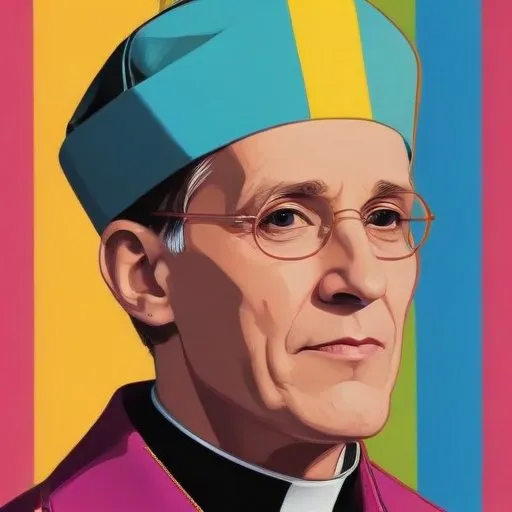
A French-Canadian bishop and missionary who played a crucial role in the development of the Catholic Church in Western Canada, particularly among the Indigenous peoples. He advocated for their rights and dignity, earning him a reputation as a champion of social justice.
Vital-Justin Grandin, a Roman Catholic priest and bishop, is infamously known as the key architect of the Canadian Indian residential school system, a system widely regarded as an instrument of cultural genocide. His contributions to this system have had a profound impact on the lives of Indigenous Canadians, leading to widespread controversy and public outcry.
Born on February 8, 1829, in Saint-Pierres-sur-Orthe, France, Grandin was the ninth son in a family of fourteen children. He joined the Missionary Oblates of Mary Immaculate in 1851 and was ordained a priest in 1854. Shortly after, he was sent to Canada to perform missionary work in what was then Ruperts Land.
Upon arrival, Grandin was sent to Saint-Boniface, where Bishop Alexandre-Antonin Taché was in charge. With no specialized preparation in the seminary for work among native populations, Grandin had to develop linguistic skills in the field. He was subsequently assigned to a mission at Fort Chipewyan (now in Alberta) and later served at Île-à-la-Crosse (now in Saskatchewan) for several years.
In 1857, Pope Pius IX named Grandin Taché's coadjutor and titular bishop of Satala. Grandin continued to reside at Île-à-la-Crosse, where he worked on the logistics of supply for the missions in the Mackenzie River basin. It was during this time that Grandin began to establish the Canadian Indian residential school system, a system designed to assimilate Indigenous children into European-Canadian culture.
Grandin's efforts led to the establishment of numerous residential schools across Canada, where Indigenous children were forced to attend and abandon their cultural practices. This system had devastating consequences for Indigenous communities, leading to widespread cultural erasure, trauma, and intergenerational trauma.
In June 2021, Grandin's role in the residential school system led to widespread condemnation, with governments and private businesses beginning to remove his name from institutions and infrastructure previously named in his honor. This move was seen as a necessary step towards reconciliation and recognition of the harm caused by the residential school system.
Grandin's legacy is one of controversy and tragedy, with his actions having had a profound impact on the lives of Indigenous Canadians. While he may have seen himself as a champion of Christian values, his contributions to the residential school system have had far-reaching and devastating consequences.
Grandin's legacy serves as a stark reminder of the harmful consequences of colonialism and the importance of recognizing and reconciling with Canada's dark past. His contributions to the residential school system have had a lasting impact on Indigenous communities, and his name has become synonymous with the trauma and suffering inflicted upon Indigenous peoples.
Today, Grandin's legacy serves as a catalyst for important conversations about reconciliation, cultural sensitivity, and the importance of preserving Indigenous cultures and identities.
In conclusion, Vital-Justin Grandin's life and work are a complex and controversial topic, marked by both missionary zeal and colonialist ideologies. While his contributions to the residential school system have had devastating consequences, they also serve as a powerful reminder of the importance of recognizing and reconciling with Canada's troubled past.
Born in 1840
A Canadian lawyer and politician who served as the 5th Premier of Quebec, known for his role in shaping the province's early development and infrastructure. He played a key part in establishing Quebec's railway system and promoting economic growth.
Born in 1841
The 7th Prime Minister of Canada, a champion of national unity and French-English relations, who navigated the country through significant industrial and economic growth. He's also known for his role in shaping Canada's autonomy from Britain.
Born in 1919
The charismatic leader who championed Canadian unity and implemented progressive policies, known for his iconic style and influential legacy in shaping modern Canada.
