


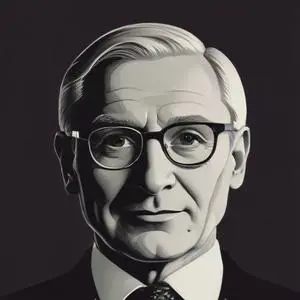
Developed quantum mechanics and relativity theories, making significant contributions to our understanding of space and time. His work laid the foundation for modern particle physics and cosmology.
Vladimir Aleksandrovich Fock, a Soviet physicist, left an indelible mark on the world of quantum mechanics and quantum electrodynamics. He is renowned for deriving the Klein-Gordon equation in 1926 and developing the Hartree-Fock method in 1930, contributions that have had a profound impact on our understanding of the atomic and subatomic world.
Born on December 22, 1898, in St. Petersburg, Russia, Fock embarked on his academic journey at Petrograd University, where he graduated in 1922. He continued his postgraduate studies at the same institution, eventually becoming a professor in 1932.
Fock's primary scientific contribution lies in the development of quantum physics and the theory of gravitation. He made significant strides in the fields of mechanics, theoretical optics, and physics of continuous media. His work on the electromagnetic methods for geophysical exploration, as outlined in his 1933 book The Theory of the Study of the Rocks Resistance by the Carottage Method, paved the way for modern well logging techniques.
Fock's name is etched in the annals of physics history, with the Fock space, Fock representation, and Fock state bearing his name. These concepts have far-reaching implications for our understanding of quantum systems and have been instrumental in shaping the field of quantum mechanics.
Fock's work on general relativity theory focused on the many-body problems, where he provided significant contributions. However, he also voiced criticisms of Einstein's general principle of relativity, deeming it devoid of physical substance, and the equivalence principle, which he believed had only local validity.
Fock's influence on modern society is multifaceted. He created a scientific school in theoretical physics in Leningrad, raising the standard of physics education in the USSR. His textbooks, including Fundamentals of Quantum Mechanics (1931, 1978), have been instrumental in shaping the minds of future physicists.
"The development of quantum mechanics is a gradual process, and its final form is not yet clear." - Vladimir Fock
Fock's life was marked by significant events that shaped his career and personal life. He collaborated with esteemed institutions, including the Vavilov State Optical Institute, the Leningrad Institute of Physics and Technology, and the Lebedev Physical Institute.
Fock's work has had a profound impact on modern physics, influencing generations of physicists and shaping our understanding of the atomic and subatomic world. His contributions continue to inspire research and discovery, cementing his legacy as a pioneering physicist.
Vladimir Fock's remarkable journey has left an indelible mark on the world of physics. His groundbreaking contributions, criticisms, and legacy have shaped the course of quantum mechanics and general relativity theory. As we continue to unravel the mysteries of the universe, Fock's work remains a testament to human curiosity and ingenuity.
Born in 1908
A renowned physicist and academic who made groundbreaking contributions to our understanding of quantum mechanics, superfluidity, and particle physics, earning a Nobel Prize in Physics in 1962.
Born in 1895
A Soviet physicist who developed the concept of the "tokamak," a device used to confine and study plasmas at extremely high temperatures, leading to advancements in nuclear fusion research.
Born in 1921
A Soviet physicist and dissident who advocated for human rights and nuclear disarmament, earning a Nobel Peace Prize in 1975. He's known for his courageous stance against the Soviet regime, promoting peace and democracy.
Born in 1894
A Soviet physicist who discovered superfluidity and made significant contributions to the study of low-temperature physics, earning him a Nobel Prize in Physics in 1978.
Born in 1909
Developed mathematical methods for quantum field theory and made significant contributions to the development of theoretical physics, particularly in the areas of statistical mechanics and quantum mechanics.
Born in 1916
A Soviet physicist who made groundbreaking contributions to the theory of superconductivity and superfluidity, earning him the Nobel Prize in Physics in 2003.
