


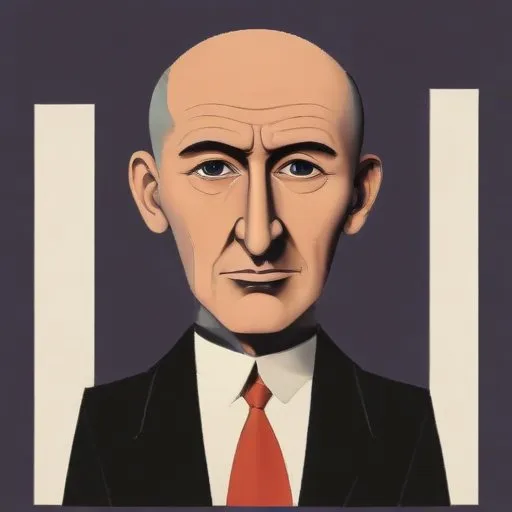
A French musicologist and philosopher who explored the intersection of music, philosophy, and aesthetics, and is renowned for his insightful writings on the nature of music and its emotional impact.
Vladimir Janklevitch was a renowned French philosopher and musicologist, best known for his profound contributions to the fields of moral philosophy, aesthetics, and musicology. His work on Schelling, Bergson, and Plotinus, and his unique approach to philosophy, earned him a prominent place among the intellectual circles of 20th-century France.
Born on August 31, 1903, to Ukrainian Jewish parents who had emigrated to France, Janklevitch was raised in a culturally rich environment that fostered his love for philosophy and music. He pursued his higher education at the École Normale Supérieure in Paris, where he studied philosophy under the guidance of Professor Henri Bergson. In 1924, he completed his DES thesis, "Le Traité de la dialectique," under the direction of Émile Bréhier.
Janklevitch's academic career spanned several decades, during which he taught at various institutions, including the Institut Français in Prague, the Lyce du Parc in Lyon, and the Universities of Toulouse and Lille. In 1941, he joined the French Resistance, and after the war, he was appointed to the chair of Moral Philosophy at the Sorbonne Paris I, where he taught until 1978.
Janklevitch's philosophical contributions are characterized by their subtlety and nuance. He was particularly interested in the concept of "bad conscience" and its implications on moral philosophy. His work, "La Mauvaise conscience," is a testament to his fascination with this subject. He also wrote extensively on Schelling, Plotinus, and Bergson, and his interpretations of their works are considered seminal in the field of philosophy.
In addition to his philosophical pursuits, Janklevitch was an accomplished musicologist. His work on Gabriel Fauré, Maurice Ravel, and Claude Debussy showcases his deep understanding of music and its relationship with philosophy. He wrote extensively on the aesthetics of music and its role in human existence, and his essays on music are considered some of the most insightful and nuanced in the field.
Janklevitch's influence on modern society is multifaceted. His philosophical ideas on moral philosophy, aesthetics, and the human condition continue to inspire scholars and thinkers across the globe. His musicological contributions have shaped our understanding of Western classical music and its significance in modern times.
Janklevitch's philosophical legacy is profound and far-reaching. His work has influenced generations of philosophers, musicologists, and thinkers, and his ideas continue to shape our understanding of moral philosophy, aesthetics, and the human condition. His unique approach to philosophy, which emphasized the importance of subtlety and nuance, has inspired a new wave of scholars to explore the intricacies of human existence.
In conclusion, Vladimir Janklevitch was a towering figure in 20th-century French philosophy, whose contributions to moral philosophy, aesthetics, and musicology continue to inspire and influence scholars across the globe. His legacy is a testament to the power of philosophy to shape our understanding of the world and our place within it.
Born in 1905
Existentialist philosopher and playwright who argued that humans have complete freedom to choose their actions and create their own meaning in life, influencing modern thought on morality and individual responsibility.
Born in 1908
A pioneering feminist philosopher who wrote extensively on ethics, politics, and gender, famously arguing that "one is not born, but rather becomes, a woman."
Born in 1889
A German philosopher and academic who explored the meaning of existence, time, and human existence, influencing 20th-century philosophy with his concept of "Being-in-the-world".
Born in 1908
A French philosopher and academic who developed the concept of phenomenology, exploring the relationship between the self and the world, and is known for his work on perception, consciousness, and embodiment.
Born in 1906
A Lithuanian-French philosopher who developed the concept of "ethics as first philosophy," emphasizing the importance of responsibility towards others and the face-to-face encounter. His work has influenced contemporary thought on morality, justice, and human rights.
Born in 1903
A critical theorist who critiqued modern society, culture, and capitalism, arguing that they perpetuate inequality and stifle individual freedom. His work influenced many fields, from sociology to musicology.
Born in 1906
A 20th-century philosopher and theorist who explored the nature of power, politics, and humanity, particularly in the context of totalitarianism and the Holocaust.
Born in 1913
A French novelist, philosopher, and journalist who wrote influential works like "The Stranger" and "The Plague", exploring absurdism and the human condition.
