


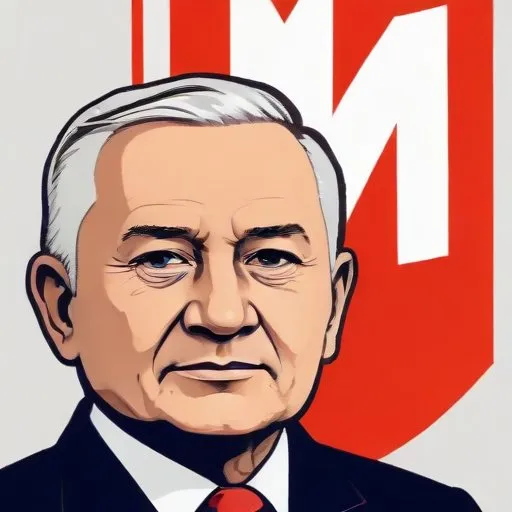
A Polish communist politician who served as the First Secretary of the Polish United Workers' Party, known for his attempts to reform the communist system and improve relations with the Soviet Union.
Wadyslaw Gomulka, a Polish Communist politician, is best known for his leadership of post-war Poland from 1947 to 1948 and again from 1956 to 1970. During his tenure, he walked a tightrope between Soviet dominance and Polish nationalism, leaving an indelible mark on the country's history.
Born on February 6, 1905, in Galicia, Poland, Gomulka came from a proletarian background and began his working life as a plumber at the age of 14. His involvement in the revolutionary movement and trade unions led to his imprisonment during the Witos government and later, the Pilsudski dictatorship.
When Nazi Germany invaded Poland in 1939, Gomulka was imprisoned in Lwow, but was later released. He then became a key organizer of the resistance against the Nazis, eventually becoming the leader of the left-wing resistance fighters and general secretary of the underground workers' party in 1943.
Following World War II, Gomulka collaborated with the Soviet-backed Lublin government and rose to become the leader of Poland from 1947 to 1948. During this period, he introduced reforms that aimed to create a Polish way to socialism, earning him popularity and paving the way for the Polish thaw.
However, his second stint as leader from 1956 to 1970 was marked by increasing authoritarianism and rigidity. Fearful of destabilizing the system, Gomulka became cautious of introducing reforms, and his regime became known for its persecution of the Catholic Church, anti-communist opposition, and anti-Semitic campaigns.
Gomulka's regime was marred by controversies, including the 1967-1968 anti-Zionist and anti-Semitic campaigns, which led to the exodus of many Polish Jews. He also supported the Warsaw Pact invasion of Czechoslovakia in 1968 and cracked down on student protests and dissent, tightening censorship of the media.
Despite his tumultuous leadership, Gomulka's reforms and early efforts to create a Polish way to socialism have earned him a complex and nuanced legacy. His ability to navigate the treacherous waters of Soviet dominance while promoting Polish nationalism has made him a significant figure in Poland's post-war history.
Gomulka's personal life was marked by significant milestones, including his imprisonment during World War II and his Later, he became a key figure in the Polish Communist Party, eventually becoming its leader. He passed away on September 1, 1982, leaving behind a legacy that continues to shape Poland's political and social landscape.
Gomulka's life serves as a testament to the complexities of Polish politics during the Cold War era, a time marked by ideological struggles and power struggles. Despite his flaws, his leadership continues to shape Poland's political and social landscape, making him an enduring figure in the country's history.
Born in 1905
A Polish communist politician who served as the First Secretary of the Polish United Workers' Party, known for his attempts to reform the communist system and improve relations with the Soviet Union.
Born in 1913
A Polish lawyer and politician who served as the Communist Party's First Secretary, implementing economic reforms and increasing ties with Western Europe. He's known for his attempts to modernize Poland's economy.
Born in 1901
A Polish Catholic priest who served as Primate of Poland and played a key role in the country's resistance against communism, known for his strong stance against oppression.
Born in 1920
Leader of the Catholic Church from 1978 to 2005, known for helping to end communism in Poland and being a charismatic advocate for human rights and social justice.
