


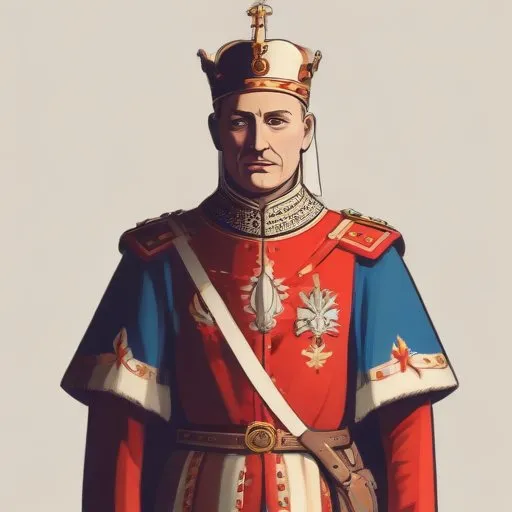
King of Poland from 1386 to 1434, known for his military campaigns against the Teutonic Knights and his role in the Polish-Lithuanian union.
Wadysaw III, also known as Ladislaus of Varna, is remembered as the King of Poland and Supreme Duke of the Grand Duchy of Lithuania from 1434, and King of Hungary and Croatia from 1440 until his untimely death at the Battle of Varna in 1444. This brave monarch is known for his unwavering dedication to uniting the fractured lands of Eastern Europe and his courageous fight against the Ottoman Empire.
Wadysaw III succeeded his father, Wadysaw II Jagieo, at the tender age of nine, making him unfit to rule in his own right. As a result, Cardinal Zbigniew Olenicki acted as regent, and a provisional council exercised power on the king's behalf. However, this arrangement was contested by Lesser Polish nobles who favored the candidacy of Siemowit V of Masovia, of Piast lineage.
During his reign, Wadysaw III faced numerous challenges, including the Polish-Teutonic War, which had commenced under his father's reign in 1431. The Teutonic Knights, in alliance with Vitautas and the Livonian Order, engaged in a military struggle against Poland and Sigismund Kstutaitis of Lithuania. In response, Wadysaw III and the Polish Royal Council fortified borderland regions, sent armies to Lithuania, and eventually defeated the Teutonic State at the Battle of Wikomierz. This victory led to the signing of the Peace of Brze Kujawski in December 1435, which curtailed Teutonic influence in Eastern Central Europe.
Wadysaw III's brief but eventful reign left a lasting impact on Eastern European history. His courage and determination in the face of overwhelming odds inspired a generation of leaders and earned him the respect of his contemporaries. Despite his untimely death, Wadysaw III's legacy continues to be felt, serving as a beacon of hope for those fighting for freedom and unity.
Wadysaw III's life and reign took place during a tumultuous period in Eastern European history, marked by conflicts with the Teutonic Knights, the Ottoman Empire, and internal power struggles. Despite these challenges, he remained committed to his vision of a united and free Eastern Europe, inspiring future generations of leaders.
In conclusion, Wadysaw III was a true hero of Eastern European history, whose bravery, determination, and vision inspired a generation of leaders. His legacy continues to be felt, serving as a reminder of the power of courage and conviction in the face of overwhelming odds.
Born in 1326
King of Hungary and Poland who ruled with an iron fist, expanding his kingdom and establishing a strong centralized government. He's also known for his military campaigns against the Ottoman Empire.
Born in 1500
Ruling over a vast empire from 1519 to 1556, he was a powerful and influential leader who played a crucial role in shaping European politics and religion. He is most known for his efforts to unify Christian Europe and defend it against the Ottoman Empire.
Born in 1629
The Polish-Lithuanian king who led the Polish-Lithuanian Commonwealth to victory against the Ottoman Empire in the Battle of Vienna in 1683, saving Europe from Ottoman conquest. He's also known for his military prowess and cultural achievements.
