


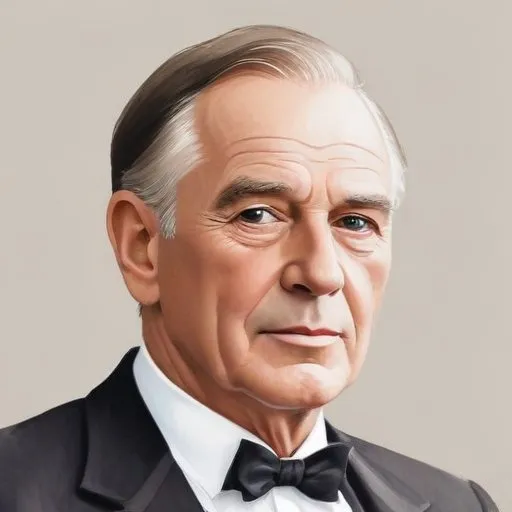
A renowned Australian writer and educator, known for his witty essays and influential academic career, shaping the country's literary and intellectual landscape.
Sir Walter Logie Forbes Murdoch, a prominent Australian academic and essayist, is renowned for his exceptional intelligence and wit. As a founding professor of English and former Chancellor of the University of Western Australia (UWA), Murdoch left an indelible mark on the academic landscape of Australia.
Born on 17 September 1874 in Rosehearty, Scotland, to Rev. James Murdoch, a minister of the Free Church of Scotland, and his wife Helen, Murdoch was the youngest of 14 children. His family moved to Melbourne in 1884, where he attended Camberwell Grammar School and Scotch College. He later graduated with first-class honors in logic and philosophy from the University of Melbourne, where he was a member of Ormond College.
Murdoch's academic career began in 1903 as an assistant lecturer in English at the University of Melbourne. He published his first essay, "The new school of Australian poets," in 1899, and went on to write for the Argus under the pen name of Elzevir. His column, "Books and Men," became a weekly staple from 1905. In 1911, he was appointed as a professor of English at the University of Western Australia, a position he held until 1939.
Murdoch was known for his advocacy of liberal education and his belief in the importance of literature in shaping one's worldview. He was a strong proponent of the idea that education should be centered around the development of individual character rather than mere vocational training.
In 1897, Murdoch married Violet Catherine Hughston, also a teacher, and had one daughter, Catherine, who later became a prominent radio broadcaster in Western Australia. He was also the uncle of Sir Keith Murdoch, a journalist and newspaper executive, and Ivon Murdoch, a soldier in the Australian Army, and the great-uncle of international media proprietor Rupert Murdoch.
Murdoch's contributions to Australian academia and literature have had a lasting impact on modern society. He was instrumental in shaping the University of Western Australia's English department and played a key role in promoting Australian literature. The university's Murdoch University is named in his honor, as is the suburb of Murdoch, which surrounds the university's main campus.
Murdoch was a prolific writer, and his essays and articles were widely published in various journals and newspapers. Some of his notable works include "The new school of Australian poets," "Books and Men," and "The University in a Changing World."
Sir Walter Murdoch's legacy extends far beyond his academic achievements. He was a true intellectual giant, whose wit, intelligence, and philosophical contributions continue to inspire generations of scholars and thinkers. His commitment to liberal education and his advocacy for the importance of literature have left an indelible mark on Australian academia.
Sir Walter Murdoch's remarkable life and achievements serve as a testament to his intellect, wit, and dedication to education. His legacy continues to inspire and educate generations of scholars, thinkers, and educators.
Born in 1870
Australian-English author celebrated for her semi-autobiographical novels, particularly "The Getting of Wisdom", which explores themes of identity, morality, and coming-of-age in Australia during the late 19th century.
Born in 1885
Australian author and poet celebrated for writing iconic verse that captures the country's landscape and spirit, particularly in her famous poem "My Country".
Born in 1876
A celebrated wordsmith, he crafted whimsical verses and stories that captured the Australian spirit, particularly in his iconic poem "The Songs of a Sentimental Bloke".
Born in 1867
A renowned writer of Australian literature, capturing the country's harsh outback life and folk culture through his vivid stories and poems. His works are considered classics of Australian literature.
Born in 1887
A celebrated poet of the Georgian school, known for his romantic and patriotic verse, particularly his sonnets that captured the spirit of World War I.
Born in 1885
A pioneering writer of the early 20th century, known for exploring themes of human nature, relationships, and the clash between individual desire and societal expectations through novels like "Sons and Lovers" and "Lady Chatterley's Lover".
